The renewed US interest in Greenland, particularly under President Donald Trump’s administration, reflects a convergence of geopolitical, economic, and environmental factors. Greenland’s strategic location in the Arctic, its vast mineral reserves, and its role in global climate governance have made it a focal point of US foreign policy.
Historical Attempts to Acquire Greenland
The United States has tried several times to acquire Greenland. In 1867, Secretary of State William Seward explored the idea after purchasing Alaska, but political backlash and Denmark’s disinterest ended the effort. In 1916, the U.S. formally recognized Danish sovereignty over Greenland in exchange for the Danish West Indies, closing the door on acquisition.
After World War II, President Truman offered Denmark $100 million for Greenland, citing its military importance, but Denmark refused. Most recently, in 2019, President Trump floated the idea publicly, calling Greenland vital for U.S. defense and resources.
Denmark and Greenland’s leaders dismissed the proposal as “absurd,” and NATO allies worried about unilateralism. These repeated failures underscore the resilience of Danish sovereignty and Greenlandic autonomy.
Timeline of U.S. Attempts to Acquire Greenland
US attempts to acquire Greenland timeline historical failures and Denmark resistance.
Security Risks and Strategic Importance
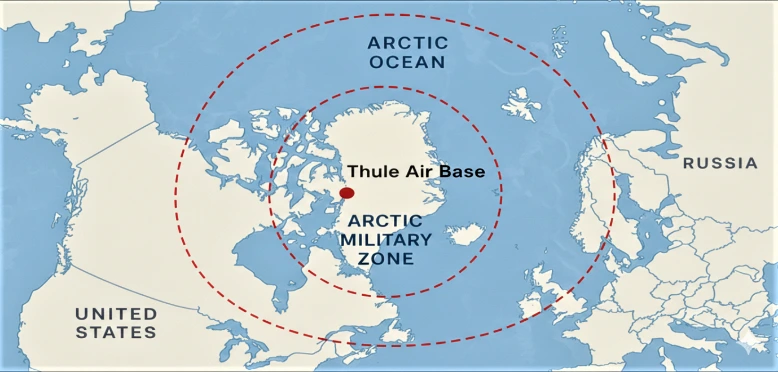
Greenland’s position in the Arctic makes it a critical node in global security. At the heart of this is the Thule Air Base, which serves as a cornerstone of U.S. and NATO missile defense and Arctic surveillance. Its location provides Washington with military leverage, enabling dominance in the Arctic and offering early‑warning capabilities against potential threats.
This strategic value is amplified by growing geopolitical rivalries. China and Russia have both expanded their Arctic ambitions, heightening U.S. concerns about maintaining control and influence in the region. As a result, Greenland is not simply a geographic asset but a linchpin in the broader architecture of Arctic defense.
Major Insight:Greenland is indispensable for U.S. Arctic defense. Implication:Sovereignty disputes could alter NATO’s security balance, creating vulnerabilities in alliance cohesion.
Thule Air Base Arctic military zone US Russia strategic map.
Economic Coercion and Resource Competition
Greenland’s mineral wealth and energy potential are central to US strategic calculations.
Rare‑Earths: Greenland’s southern deposits (neodymium, dysprosium, terbium, praseodymium) are vital for smartphones, batteries, wind turbines, and defense systems like jet engines, radar, and precision weapons. They offer the U.S. a potential alternative to China’s dominance in rare‑earth supply chains.
Energy Security: U.S. control of Greenland’s rare‑earths and oil reserves could reduce reliance on China and Middle Eastern imports, strengthen NATO energy security, and stabilize supply chains. However, it would intensify rivalry with China and Russia.
Major Insight:Greenland could reshape global supply chains for rare-earths. Implication: Resource competition risks escalating US-China tensions.
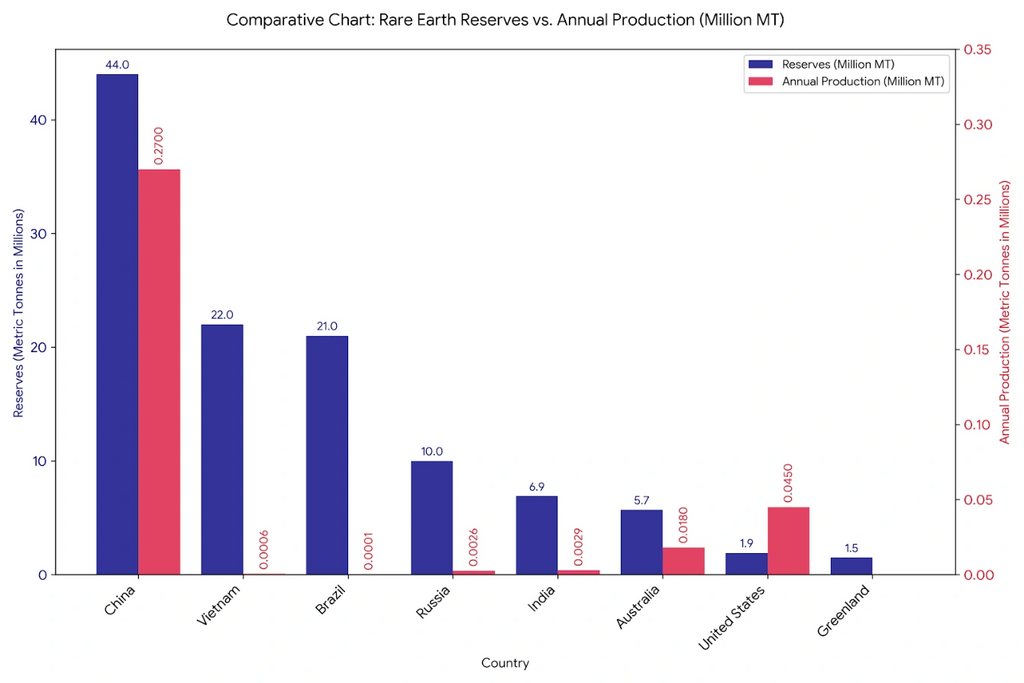
Rare earth reserves vs production China US Greenland global comparison.
Comparative Analysis: Reserves vs. Production
While a country may have high reserves, it does not always equate to high production. The chart below illustrates the stark contrast between what is "in the ground" (Reserves) and what is actually being extracted annually (Production).
China is the only nation with both massive reserves and high production, currently providing over 69% of the world's mine output.
Vietnam and Brazil hold significant reserves but contribute negligible amounts to the global supply, as many of their projects are still in the early development or exploration phases.
The United States has significantly smaller reserves than the top three, yet it is the world's second-largest producer, extracting nearly 45,000 MT annually from the Mountain Pass mine in California.
Geopolitical Coercion and International Relations
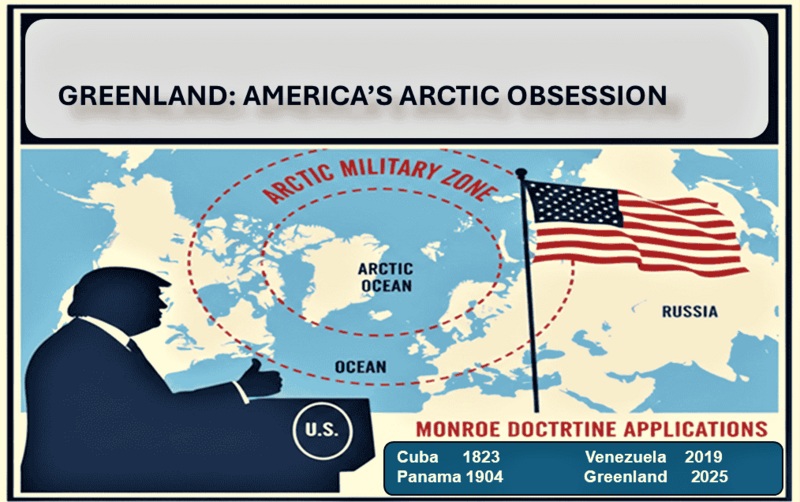
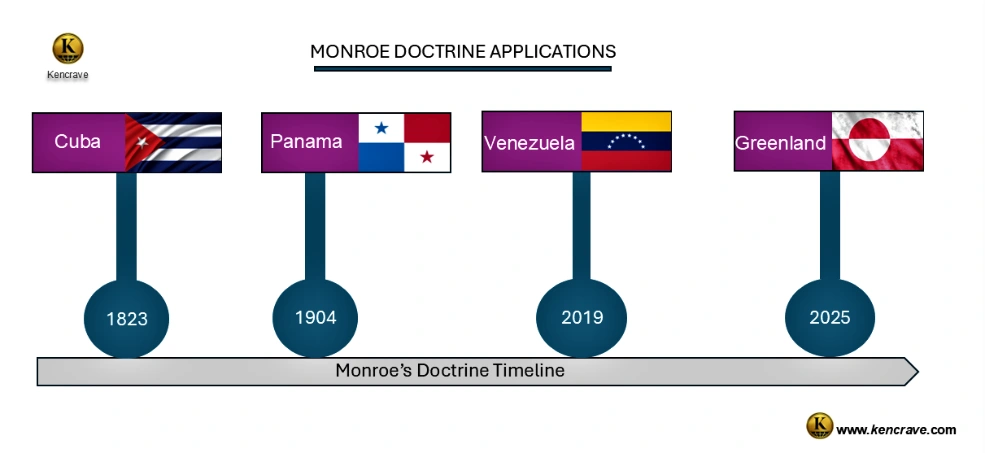
The Monroe Doctrine has been invoked to justify U.S. interests in Greenland, reframing Arctic security as part of hemispheric defense. From Washington’s perspective, any foreign involvement in Greenland is seen as a direct threat to national security.
Denmark, however, has resisted these overtures, emphasizing sovereignty and warning that unilateral U.S. moves could strain NATO unity. This tension creates the risk of fractures within both NATO and EU alignment, as allies weigh the balance between collective defense and national autonomy.
Major Insight: Trump’s extension of Monroe Doctrine logic into the Arctic sets a precedent for unilateral U.S. action beyond Latin America. Implication:Such moves could destabilize alliance cohesion and reshape Arctic geopolitics.
Monroe Doctrine timeline history of Cuba, Panama, Venezuela and Greenland.
Environmental and ESG Considerations
Greenland’s environmental role makes it central to global ESG debates. The melting of its vast ice sheets has become one of the most visible drivers of global sea‑level rise, a trend that has accelerated over the past decade and is often illustrated in climate data charts, as shown below.
This environmental shift is not only a scientific concern but also a geopolitical one, as rising seas affect coastal populations worldwide.
Greenland ice sheet mass loss vs global sea level rise 2015–2025 climate graph.
At the same time, indigenous Inuit communities face cultural and livelihood disruptions from resource extraction and militarization. Their rights and traditions are increasingly at the forefront of international discussions about sustainability.
Governance adds another layer of complexity: Greenland’s autonomy within the Kingdom of Denmark complicates questions of sovereignty and long‑term stewardship of its resources.
Major Insight: Greenland stands as a test case for whether powerful nations can balance resource extraction with ESG priorities. Implication:Environmental and social concerns could significantly limit U.S. exploitation of Greenland’s resources, even if strategic interests remain strong.
Greenland ice melt vs global sea level rise bar chart 1993–2023 climate data.
Risk Assessment
Greenland risk assessment table comparing US vs Denmark military economic geopolitical ESG positions.
Global Consequences
Greenland’s future carries weight far beyond its borders. If the United States were to gain control over Greenland’s rare‑earths and oil reserves, it could fundamentally reshape global supply chains.
Rare‑earth elements from Greenland would provide Washington with a secure alternative to China, which currently dominates global production and processing. This would strengthen U.S. technological independence, ensuring steady supplies for clean energy industries and defense systems such as radar, jet engines, and precision weapons.
Similarly, tapping Greenland’s oil and gas reserves could diversify U.S. energy sources, reducing reliance on Middle Eastern imports and reinforcing NATO’s energy security framework.
Yet, this pursuit of energy security collides with climate governance. Greenland’s role in Arctic climate policy makes U.S. involvement controversial, as resource extraction risks accelerating ice melt and global sea‑level rise.
Sovereigntydisputes with Denmark further complicate matters, raising the possibility of alliance strains if Washington overrides Danish authority. Meanwhile, China and Russia frame U.S. ambitions as neo‑imperialism, intensifying multipolar rivalry in the Arctic.
Major Insight: Greenland is not just territory; it is a pivot for global energy, climate, and security. Implication:Arctic geopolitics could redefine the multipolar world order, reshaping alliances and resource markets alike.
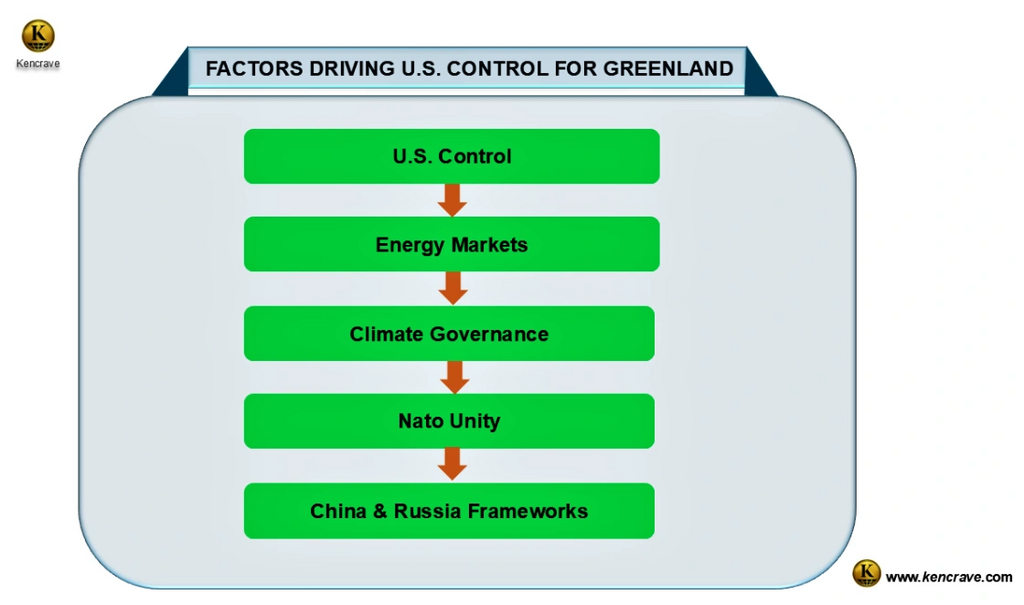
Flowchart of U.S. Control of Greenland, its impact on energy markets, climate, Nato unity, China and Russia frameworks.
Key Takeaways
Military Imbalance: Greenland is central to US Arctic defense.
Resource Race: Rare-earths and oil make Greenland strategically vital.
Monroe Doctrine Revival: Trump reframed hemispheric security to include the Arctic.
ESG Flashpoint: Climate and indigenous rights complicate exploitation.
Global Fallout: Energy markets, NATO unity, and multipolar rivalry all hinge on Greenland’s future.
FAQs
1. Why is Greenland important to the US?
Greenland is crucial for the US due to its strategic military positioning (Thule Air Base), its vast mineral resources, and its potential to influence global energy markets.
2. What is the Monroe Doctrine's relevance to Greenland?
The Monroe Doctrine, historically applied to Latin America, has been extended by Trump to include the Arctic, framing Greenland as a key part of hemispheric security.
3. How could Greenland affect global resource markets?
Greenland’s vast reserves of rare-earth minerals and oil could reshape global supply chains, reducing reliance on foreign resources and increasing competition, particularly with China.
4. What are the environmental concerns regarding Greenland?
Greenland’s melting ice sheets contribute significantly to global sea-level rise, and foreign investments and militarization could disrupt local communities and raise ESG (Environmental, Social, and Governance) concerns.
5. How does Greenland’s sovereignty affect international relations?
Denmark’s resistance to US influence over Greenland creates tensions within NATO and could have broader geopolitical implications, especially with Russia and China’s growing interests in the region.
A new economic order is emerging from Silicon Valley and Toronto’s AI hubs. North America faces a choice: will it build an intelligent capitalism economy that spreads prosperity fairly, or...
.png)


.png)