A new economic order is emerging from Silicon Valley and Toronto’s AI hubs. North America faces a choice: will it build an intelligent capitalism economy that spreads prosperity fairly, or will a few tech companies control wealth and power, leaving most people behind?
Digital feudalism refers to a scenario where a handful of corporations control critical data, AI platforms, and digital infrastructure, limiting opportunity and concentrating power. The choices made today will shape society, economy, and democracy for decades.
Intelligent Capitalism and the New Drivers of North American Tech Wealth
Wealth creation has shifted from traditional industries to data-driven technology, AI, and software innovation. The U.S. leads in research, technology investment, and unicorn startups. According to PitchBook, U.S. venture capital investment in AI startups reached $50 billion in 2023 alone.
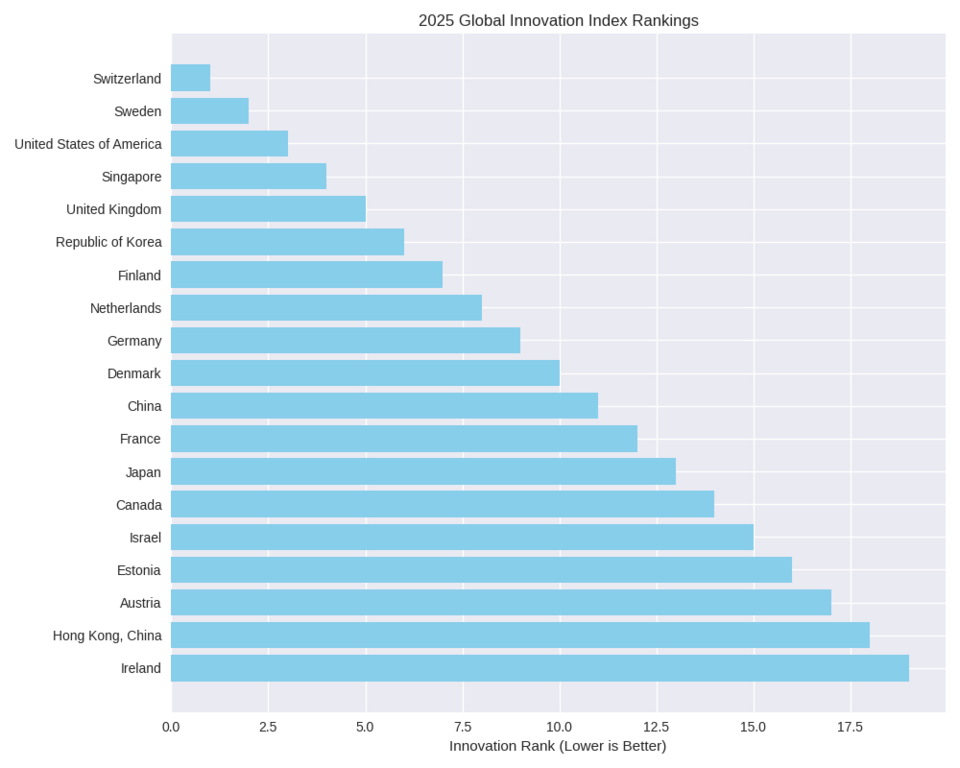
In 2025, North America stood out as the world’s most innovative regions with the US taking third place in the global ranking by Global Innovation Index while Canada contrived to keep position fourteen.
2025 Global Innovation Index ranking chart of top countries including Switzerland, USA, China, and Singapore. Source: Global Innovation Index
Key Highlights from the Chart
Top 5 innovators: Switzerland, Sweden, USA, Singapore, UK.
Asia’s leaders: Republic of Korea (6), China (11), Japan (13), Hong Kong (18).
European strength: Finland, Netherlands, Germany, Denmark, France, Estonia, Austria, Ireland.
North America: USA (3), Canada (14).
Canada’s tech Hubs: Vancouver, Toronto, and Montreal, have become global AI innovation centers. Toronto hosts the Vector Institute, funded by government and private sectors, while Montreal has over 200 AI startups and strong academic partnerships. These hubs are reshaping industries such as healthcare technology, financial services, logistics, and digital entertainment.
Globally, North America competes with:
European Union: Known for ethical AI regulations like the EU AI Act.
China: Investing heavily in AI-driven manufacturing and surveillance.
AI Governance in North America: Risks of a Governance Gap
Technology has advanced faster than regulation. In the U.S., no federal AI law exists; state-level rules create uncertainty. In Canada, 85% of citizens support stronger AI oversight. The Canadian AI and Data Act aims to provide a national framework for AI governance, risk management, and digital accountability.
Failing to close this governance gap risks:
Over-regulation that stifles innovation.
Under-regulation that enables monopolies and public mistrust.
Blueprint for AI and Data Governance: A New Social Contract
North America needs a new approach to govern technology, focusing on four key areas:
Modernize Intellectual Property Rules for AI Innovation: Patent laws should reward new ideas while allowing derivative works, preventing large companies from blocking competition. The IP regimes are central to the fate and future of innovation (International IP Index | U.S. Chamber of Commerce,2025).
Protect Data and Make AI Transparent: Citizens should know how their data is collected and used. Policies should align with frameworks like the EU AI Act, requiring risk assessments and explainable AI in critical systems.
Ensure Fair Workplaces with Algorithm Rules: AI tools in hiring and employee monitoring must be accountable. Pilot programs in Canada test algorithmic impact assessments for public sector hiring.
Prevent AI Monopolies with Pro-Competition Rules: Strong antitrust laws prevent “winner-takes-all” markets and support smaller companies. EU and U.S. cases against tech giants provide guidance for fair digital markets.
The Human Impact of AI and Automation on North American Workforces
The 2025 Global AI Jobs Barometer is indicative of the changing momentum in the workforce. Artificial intelligence is not quite replacing the workforce but rather altering the nature of their roles marginalizing some and making others more valuable. Such roles altered include:
Customer service representatives: Chatbots are being used to conduct routine inquiries as human personnel handle complicated or exclusive problems.
Administrative assistants:Activities such as scheduling, emails sorting, and drafting of documents have been automated.
Data analysts: AI tools are now applied to conduct pattern detections and preliminary data collection. This pushes analysts to focus on interpretation and oversight.
Companies like Amazon, the second largest private employer in the U.S., note AI tools would thin their ranks and a reduction of the headcounts in the years to come owing to the efficient gains from the use of AI. Reskilling programs in AI literacy, data, and critical thinking are essential. The goal is human-AI augmentation, ensuring AI enhances human productivity rather than replacing workers.
AI Wealth Concentration and Equity: Who Benefits from Innovation
In the face of this tech revolution, the question of equity arises as to who truly are the actual beneficiaries of North America’s innovation wave returns.
Much of the wealth created by the tech and innovation engines revolve within the highly skilled and the venture-backed startups, not to forget the large tech firms themselves. This has raised the question of distribution and the flow of the wealth created.
Oxfam reports that the top 1% of Americans captured nearly two-thirds of new wealth created since 2020, largely from tech investments. Without intervention, digital feudalism risks creating a permanent class divide.
Policy solutions include:
Data Dividends: Citizens receive a share of profits from their data (as proposed in California).
Inclusive Investment Programs: Public or citizen-backed investment in startups ensures broader participation.
Social Support Programs: Progressive taxes fund lifelong learning, retraining, and safety nets, including potential basic income.
Feasibility requires political will, public engagement, and careful design to avoid stifling innovation.
The Path Forward for AI and Technology Policy in North America
North America can either:
Move toward digital feudalism, with monopolies, insecure work, and widening inequality.
Build intelligent capitalism, balancing innovation with fairness, investing in workers, and ensuring equitable wealth distribution.
Smart governance, clear policies, and investment in human capital can ensure AI benefits society, not just corporations. The future is shaped by choices made today.
FAQ: North American AI, Automation, and Equity
Q1: What is digital feudalism in North America? A: It occurs when a few tech companies dominate AI platforms and data, limiting opportunities for most people.
Q2: How is AI affecting North American jobs? A: AI automates routine tasks but increases demand for problem-solving, oversight, and human-AI collaboration skills.
Q3: What policies can promote fair AI growth? A: Data dividends, inclusive investment, updated intellectual property rules, fair workplace laws, competition rules, and social support programs.
Q4: How does Canada compare to the U.S. in AI governance? A: Canada focuses on stronger oversight with the AI and Data Act, while the U.S. relies on inconsistent state rules.
Q5: How can North America avoid inequality from AI? A: By building intelligent capitalism that balances innovation with fairness, protects workers, and prevents monopolies.
The renewed US interest in Greenland, particularly under President Donald Trump’s administration, reflects a convergence of geopolitical, economic, and environmental factors. Greenland’s strategic location in the Arctic, its vast mineral...