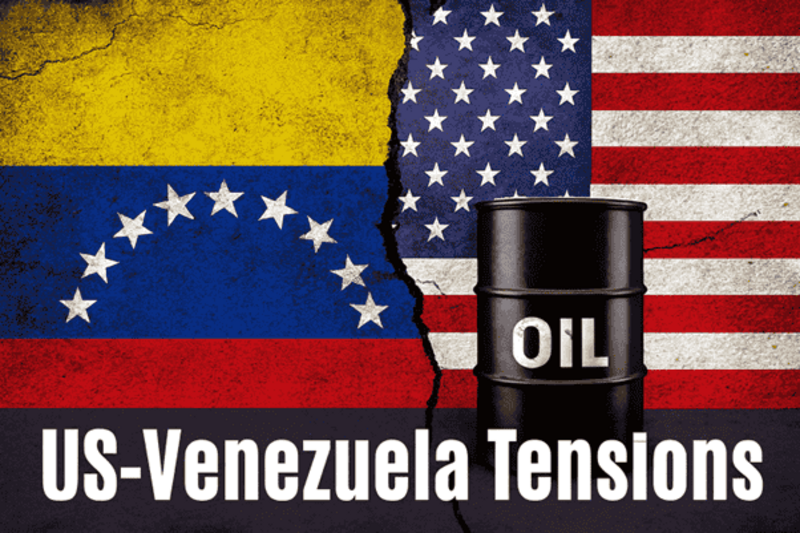
The conflict between the United States and Venezuela, particularly in 2025 and 2026, has escalated to a point where both military and economic consequences are becoming increasingly significant on the global stage. This escalation began after the US seized a Venezuelan oil tanker, citing violations of sanctions, and deployed significant military assets to the Caribbean. Tensions continue to rise as both nations struggle over control of oil resources and respond to political maneuvering.
The Capture of Venezuelan President Nicolás Maduro: US Military Operation and Political Fallout
Maduro’s capture marked a turning point in the ongoing conflict between the U.S and Venezuela.
The capture not only reshaped Venezuela’s internal power dynamics but also sent shockwaves across the international community. For the rest of the world, such development of Venezuela's President Maduro, raises questions about sovereignty, interventionism, and the precedent it sets for global geopolitics.
Looking ahead into 2026, Venezuela’s political environment is likely to undergo profound shifts. The removal of Maduro creates both opportunities and uncertainties:
Domestic Transition: Competing factions within Venezuela may vie for control, potentially leading to either a fragile interim government or intensified instability.
Regional Impact: Neighboring Latin American states will be forced to recalibrate their diplomatic and economic ties, with some welcoming the change and others condemning the intervention.
Global Consequences: Major powers such as Russia and China are expected to respond strongly in different fronts, framing the capture as a challenge to multipolarity and international law.
Future Outlook: For Venezuela, 2026 could be marked by contested elections, economic restructuring attempts, and heightened social unrest as citizens grapple with uncertainty about the nation’s trajectory.
Understanding the Monroe Doctrine’s Influence on US-Venezuela Relations: A Historical and Geopolitical Perspective
The Monroe Doctrine has played a central role in shaping US foreign policy toward Latin America, including Venezuela. The Monroe Doctrine has been used to justify US interventions, and its relevance in the 2025-2026 US-Venezuela.
What the Monroe Doctrine Is
Origin (1823): Introduced by President James Monroe, the doctrine warned European powers against further colonization or interference in the Americas.
Core Principle: The Western Hemisphere was to remain under US protection, with any external meddling seen as a threat to US security.
Evolution: Initially defensive, it later became a justification for US dominance and intervention across Latin America.
How It Has Been Used to Justify US Interventions
19th–20th Century: Invoked during interventions in Cuba, Panama, and Central America to block European influence and secure US economic interests.
Cold War Era: Used to counter Soviet presence in the region, reinforcing US hegemony.
Modern Examples: Interventions in places such as Grenada (1983) and Panama (1989) were framed under Monroe Doctrine logic.
Relevance in the 2025 - 2026 US - Venezuela Conflict
Revival of the Doctrine: President Donald Trump explicitly cited the Monroe Doctrine to justify the capture of Nicolás Maduro, portraying Venezuela’s ties with foreign adversaries as a violation of hemispheric security.
Strategic Justification: The doctrine was reframed as a “Trump Corollary” or “Donroe Doctrine,” emphasizing unilateral US action to secure its sphere of influence.
This framing transforms the Venezuela crisis 2025 - 2026from a sanctions dispute into a doctrine-driven confrontation.
Global Fallout and Regional Impact:
Latin American states are divided, with some supporting the US stance and others condemning it as neo-imperialism.
International Response: Russia and China criticized the move, arguing it undermines sovereignty and international law.
Future Outlook: Venezuela’s political environment in 2026 is expected to remain volatile, with contested leadership and heightened geopolitical tensions.
US-Venezuela Military Dynamics: An Uneven Power Balance
The US military holds a clear technological and numerical advantage over Venezuela, but Venezuela has developed asymmetric defense strategies to counteract this imbalance.
US vs Venezuela military power comparison Caribbean 2025 chart, troop deployments, naval assets, air power analysis.
Troop Deployment in the Caribbean
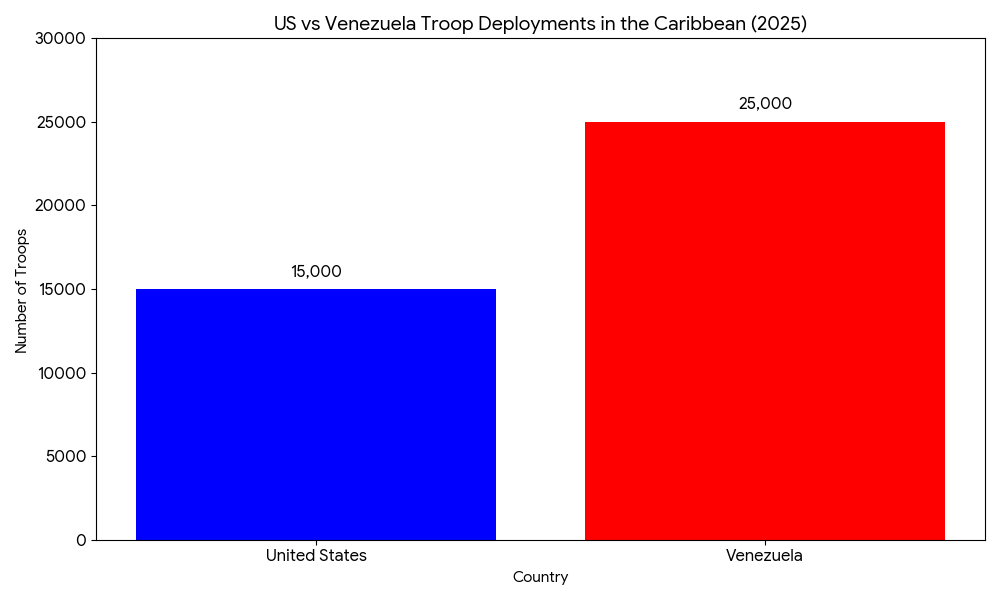
While the US has a significant advantage in troop numbers and military technology, occupying Venezuela would come at a high cost.
US vs Venezuela Caribbean troop deployments 2025 bar chart, military presence comparison, Venezuela 25,000 vs US 15,000 troops.
Internal Political Dynamics: US and Venezuela’s Domestic Constraints
The internal political landscapes in both the US and Venezuela will play a crucial role in the escalation of this conflict. In the US, Congress would likely be a key decision-maker regarding military action. Public opinion, especially in the context of US foreign policy fatigue, could push for a more cautious approach.
In Venezuela, the unification of the military behind Maduro’s regime is a critical factor. While Maduro retains substantial support, particularly among the military, dissent and unrest could undermine his authority, especially in the face of prolonged external pressure.
The Role of Regional Bodies: Implications for Global Governance
Regional organizations like the UN and the Organization of American States (OAS) have the potential to influence the conflict's trajectory. These bodies will likely be involved in diplomatic efforts to mediate and de-escalate the situation, but their ability to enforce peace could be limited.
The involvement of global powers and the lack of consensus on Venezuela within the international community complicate the role of these organizations.
Economic and Geopolitical Impact: The Consequences of Escalation
Oil Market Disruptions and Industry Repercussions
Venezuela’s vast oil reserves make it a key player in global energy markets. The conflict has the potential to disrupt Venezuela’s oil production, which would push global oil prices higher. Given that Venezuela is a major supplier, particularly to countries like China, any disruption would have wide-reaching consequences.
Impact on Major Global Players
China As a major oil importer from Venezuela, China is likely to feel the effects of any disruption in oil supply. This could further strain its energy security efforts, especially given its growing demand for energy and the importance of stable oil imports for its economy.
Iran Iran, which shares some geopolitical interests with Venezuela, could also face significant implications. Any disruption in Venezuela’s oil production could further exacerbate the already strained energy market. As an oil-exporting nation, Iran may see its position in the global market shift, especially if oil prices rise significantly, leading to changes in its own energy exports and relations with other oil-importing nations.
Global Financial Markets As oil prices rise, stock markets in oil-importing nations, particularly in Europe and Asia, would face volatility. Investors would need to brace for oil price spikes and currency fluctuations, especially in emerging markets that rely heavily on oil imports. Increases in oil prices could lead to inflationary pressures, impacting businesses and consumers alike.
Implications for Industries
A disruption in oil exports from Venezuela could severely impact industries dependent on stable energy prices, including manufacturing, transportation, and energy production. Furthermore, insurance premiums for shipping and oil-related businesses could see significant increases due to the heightened risks in the region.
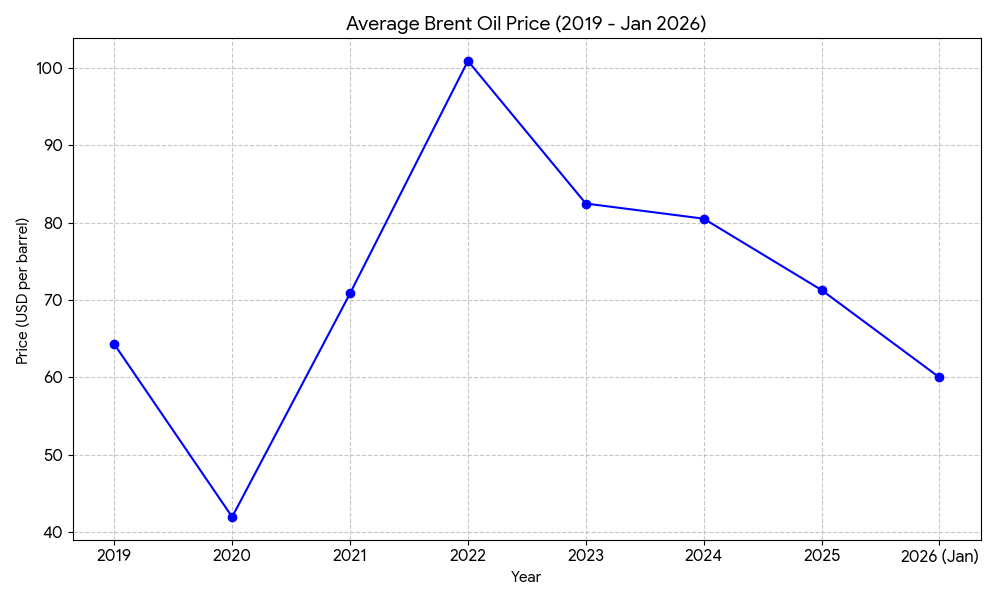
Average Brent oil price 2019–2026 line chart, global crude market trends, pandemic slump, 2022 peak, and 2025 decline. Sources: Statista and US EIA
Key Insights from the Chart
2019–2020: Prices fell from estimate of $64 to $42 due to the COVID‑19 pandemic and global demand collapse.
2021–2022: Strong rebound, peaking at estimated $101 in 2022, driven by supply constraints and geopolitical tensions (including Russia–Ukraine war).
2023–2024: Stabilization around estimated $80–83, reflecting partial recovery and OPEC+ production adjustments.
2025: Decline to estimated $71, showing easing demand and oversupply pressures.
2026 (Jan): Prices trending lower (estimated $60), suggesting weaker global demand and increased production capacity.
Risks
Short-term: Venezuela’s instability could cause sudden price spikes, especially if production halts.
Medium-term: Even with declining Brent averages in 2025–2026, geopolitical shocks from Venezuela could reverse the downward trend.
Long-term: Energy security calculations increasingly factor Venezuela’s reserves, meaning regime stability will remain a critical variable for global oil markets.
Implications to Industries and Sectors
1.Energy-Intensive Industries at Risk: Sectors like aviation, manufacturing, and logistics face rising operational costs and reduced margins.
2.Inflationary Pressures Globally: Higher oil prices contribute to inflation, especially in import-dependent economies across Africa, Asia, and Europe.
3. Geopolitical Leverage for Oil Exporters: Countries like Iran benefit from elevated prices, potentially reshaping global alliances and trade flows.
4.Investor Strategy Shift: Investors may pivot toward energy stocks, commodities, and geopolitical risk hedges, while avoiding vulnerable sectors.
Geopolitical Fallout: Regional and Global Implications
The US-Venezuela conflict would have significant geopolitical repercussions, including:
Migration Pressures: A full-scale war could exacerbate the already severe migration crisis, especially toward neighboring countries like Colombia and Brazil. The millions of Venezuelan refugees would place immense pressure on regional resources and infrastructure.
Geopolitical Realignment: Venezuela’s growing ties with China would likely intensify, complicating US foreign policy. China may increase its support for Venezuela, further challenging US diplomatic and economic strategies.
Energy Security: Europe and Asia could face renewed volatility in oil imports, with Venezuela's role in the global energy market being key. A prolonged conflict could affect energy supply chains and increase energy security risks worldwide.
Caribbean Economies: Countries in the Caribbean heavily reliant on tourism and shipping would face significant economic challenges due to military escalation and the potential for collateral damage in the region.
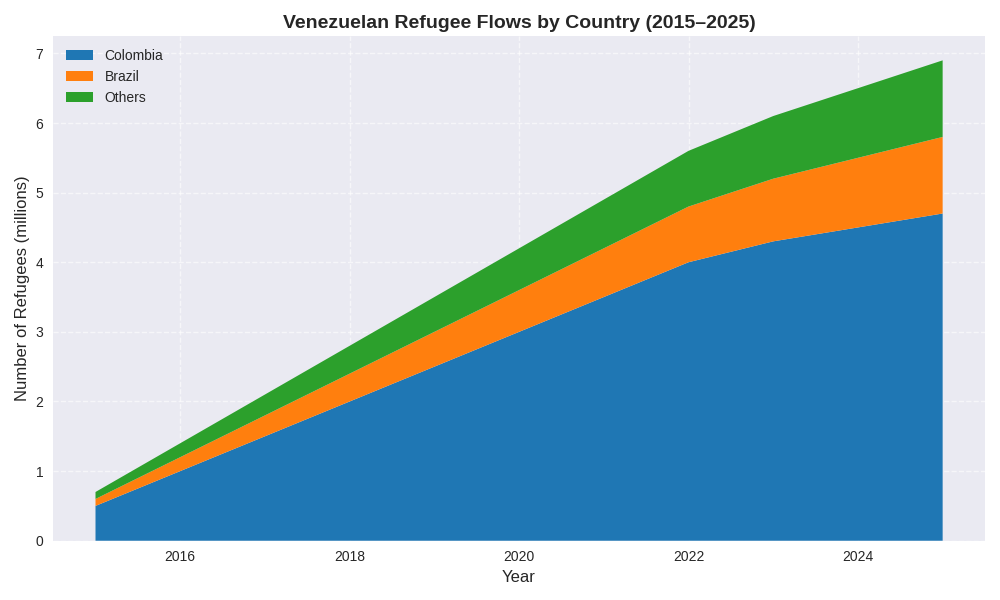
Stacked area chart of Venezuelan refugee flows illustrating migration pressures on Colombia, Brazil, and other countries.
Key Insights from the Chart
Steady Growth in Refugee Numbers: The total number of Venezuelan refugees has consistently increased from 2015 to 2025, reaching nearly 7 million by the end of the period.
Colombia as Primary Destination: Colombia has absorbed the largest share of refugees throughout the decade, indicating its central role in regional humanitarian response.
Brazil’s Rising Burden: Brazil’s intake has grown steadily, especially after 2020, suggesting increased migration pressure and potential strain on public services.
Diversification of Destinations: The “Others” category shows a gradual rise, implying that Venezuelan refugees are increasingly seeking asylum in a broader range of countries beyond immediate neighbors.
Implications
Regional Strain: Colombia and Brazil face mounting challenges in housing, healthcare, and employment for refugees, which may destabilize local economies and politics.
International Humanitarian Demand: The growing refugee numbers call for expanded support from global institutions like UNHCR, IOM, and donor nations.
Migration Policy Pressure: Neighboring countries may tighten border controls or revise asylum policies, potentially leading to humanitarian bottlenecks.
Global Governance Test: The scale and persistence of the crisis underscore the need for coordinated international action and burden-sharing mechanisms.
The Stakes Ahead
The US–Venezuela conflict of 2025-2026 is no longer just a bilateral dispute; it has become a flashpoint with far-reaching economic and geopolitical implications. Businesses, policymakers, and regional governments must prepare for oil market volatility, disrupted trade routes, and increased migration flows. While a negotiated settlement remains possible, the prevailing trend suggests that the conflict will continue to simmer, posing significant risks to global stability.
Key Takeaways from the US-Venezuela Conflict in 2025
1. Military Imbalance: The US has superior military capabilities, but Venezuela’s reliance on asymmetric tactics presents serious challenges to a US occupation.
2.Oil Market Volatility: Disruptions in Venezuela’s oil production could significantly impact global oil prices and affect major players like China.
3. Economic Impact on Regional Economies: Caribbean economies, particularly in tourism and shipping, are vulnerable to the ongoing military buildup and potential conflict.
4. Migration and Humanitarian Crisis: A full-scale conflict could worsen the Venezuelan refugee crisis, with neighboring countries like Colombia and Brazil bearing the brunt.
5.Geopolitical Realignment: Venezuela’s growing ties with China add a layer of complexity to US foreign policy, further influencing the conflict’s dynamics.
1. What are the primary causes of the US-Venezuela conflict in 2025?
The conflict is driven by disputes over oil resources, drug trafficking accusations, sanctions enforcement, and contested elections. Covert US operations have further escalated tensions.
2. How will the US military’s involvement impact Venezuela’s defense?
While the US has superior military technology, Venezuela relies on asymmetric defense strategies, including missile systems and coastal defenses, to counterbalance the US advantages.
3. What effect will the conflict have on global oil prices?
Any disruption to Venezuela’s oil production could significantly raise global oil prices, affecting global markets and industries dependent on stable energy costs.
4.How will the Venezuelan refugee crisis evolve during the conflict?
A full-scale war would likely accelerate migration flows, especially towards neighboring Colombia and Brazil, placing immense pressure on regional economies and humanitarian resources.
5. What role does China play in the US-Venezuela conflict?
China has strong ties with Venezuela and is expected to deepen its support, complicating US foreign policy and adding a layer of global geopolitical tension.
Venezuela is reasserting itself as a geopolitical disruptor in the Western Hemisphere, leveraging vast oil reserves, ideological alliances, and defiance of Western sanctions to challenge U.S. influence. Its actions reverberate...
Argentina’s 2025 midterm elections, held on 26 October 2025, renewed half of the Chamber of Deputies (127 of 257 seats) and one-third of the Senate (24 of 72 seats). As...
%20(1).png)