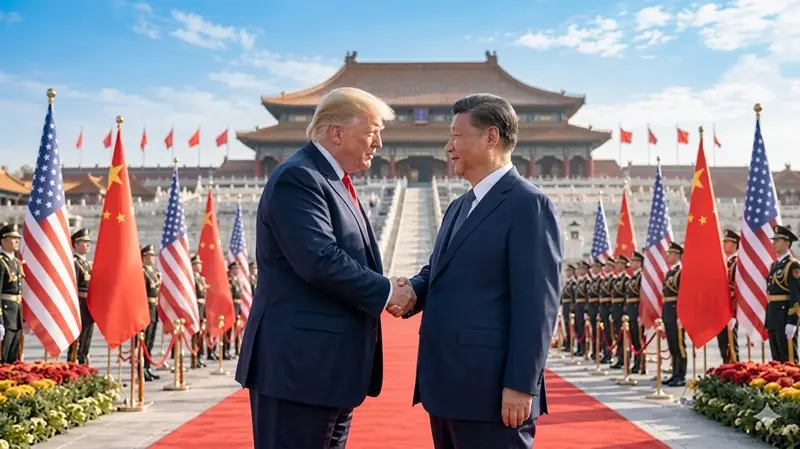
Donald Trump and Xi Jinping handshake ceremony in Beijing, symbolizing U.S.–China diplomatic relations, global trade dialogue, and international cooperation. Image credits: "Donald Trump & Xi Jinping" by Gia Thưởng is marked with Public Domain Mark 1.0.
Asia
Executive Summary
China has risen from a manufacturing-focused economy into a major global power shaping trade, finance, technology, and diplomacy. Its influence is reflected in initiatives like the AIIB, BRICS expansion, RCEP, and the Belt and Road Initiative. This has extended its reach across developing economies while increasing financial exposure.
However, China’s growth is facing new constraints that include slowing domestic momentum, demographic decline, and increased strategic competition from the United States, Europe, and regional powers.
The result is a shifting global system where China is a central player, but its influence is increasingly balanced by structural limits and geopolitical resistance.
Key Takeaways
China’s global influence is increasingly integrated in long-term institutional and supply chain architecture rather than short-term economic cycles.
The international system is shifting toward managed geopolitical competition, with China as a central but contested player.
Beijing’s future influence will depend on balancing external expansion with internal structural pressures in its economy and demographics.
China’s Economic Rise and Global Power Strategy (2000–2026)
China is no longer just a participant in the international order but also a key driver of global policy. This has been a long decade strategy by China to not only match its economic growth but also geopolitical influence. The country has undergone an unprecedented GDP growth over the last 25 years, 2000-2025, from a nominal GDP of $1.22 trillion to approximately $19.63 trillion. It has built strong buffers to withstand global shocks.
Over these 25 years, the country transformed from the world’s sixth-largest economy into the undisputed global manufacturing powerhouse and the second-largest economy by nominal GDP. As Beijing moves past its era of double-digit GDP expansion, its approach to global governance has adapted. It now emphasizes high-quality technological leadership and alternative multilateral institutions to form a multilayered strategy in its next growth phase.
China’s nominal GDP growth chart 2000–2025 — line graph showing rapid economic expansion from $1.22 Trillion to $19.63 Trillion USD. It highlights China’s sustained rise as a global economic power.
Its geopolitical leverage has been more visible in recent times. Beijing under Xi Jinping hosted back-to-back summits with US President Donald Trump (13–15 May 2026) and Russian President Vladimir Putin (19–20 May 2026). By hosting the leaders of the world's other two major superpowers less than a week apart, Chinese President Xi Jinping completely changed the traditional rules of global diplomacy. Now, China is a central player in global policing and economics.
Global power dynamics chart— China positioned as the central pivot between Washington, USA, and Moscow, Russia, highlighting Beijing’s strategic role in international relations and global Affairs.
How China Built Parallel Global Institutions (AIIB, BRICS, RCEP)
A decade ago, China operated within the bounds of Western-dominated financial networks. Over the past 10 years, Beijing built and scaled an alternative, parallel architecture of global governance and financial policy to challenge traditional, Western-led bodies like the International Monetary Fund (IMF) and the World Bank. China’s success over the decade was realized through:
The Maturity of the AIIB: Launched in 2015, the Asian Infrastructure Investment Bank (AIIB) has expanded from 57 founding members into a massive multilateral lender commanding over 110 approved member nations globally. AIIB has fostered sustainable economic development and improved infrastructure connectivity in Asia.
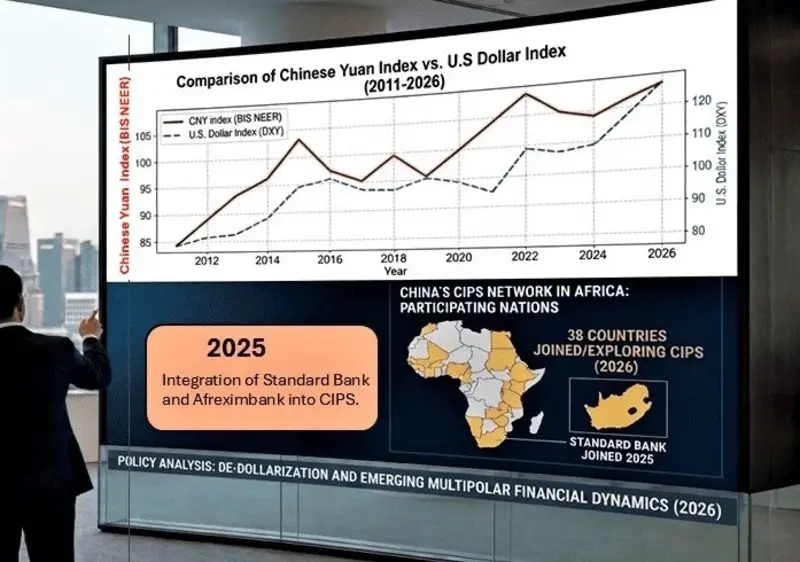
BRICS Expansion: China successfully led the expansion of the BRICS bloc, transforming it from an informal economic club into an institutional vehicle for de-dollarization and political alignment across the Global South. This has led to adoption of BRICS payment systems among the members, reducing reliance on the dollar and euro payment mechanisms.
This was clear during the May 2026 meeting between China’s President Xi Jinping and Russia’s President Xi Jinping. The two leaders reaffirmed that all bilateral trade between Russia and China is now conducted using the Chinese yuan and Russian ruble.
China’s Role in Asia-Pacific Trade Integration: Beijing anchors the Regional Comprehensive Economic Partnership (RCEP), currently the world's largest free trade agreement, to strengthen trade integration across 15 Asian nations.
The Belt and Road Initiative: Global Infrastructure Power and Debt Exposure
The Belt and Road Initiative (BRI), a decade after its launch is one of the largest infrastructure projects in modern history replicating the traditional trade route (The Silk Road).
In the last decade, the project shifted from reckless spending on infrastructure to managing a complex, risky budget.
The Total Spending: China’s BRI spending has topped to about $1.4 trillion since 2013. Over $700 billion went into construction and an estimated $530 billion went into non-financial investments.
The Surge in Trade: For Beijing, the commercial return has been positive. China’s trade with Belt and Road partner countries reached approximately $3.3 trillion in 2025, according to official Chinese government data. This reflects steady, long‑term growth over the decade. BRI partners accounted for more than half of China’s total trade, underscoring the initiative’s expanding commercial significance.
The Outstanding Debt Burden: The initiative is no longer about construction expansion but also about managing a massive debt crisis. The Stanford Center on China’s Economy and Institution notes that Chinese banks such as China Development Bank and the Export-Import Bank of China are left managing more than $1.1 trillion in outstanding debt globally.
The Distress Trap: Approximately 80% of Chinese lending in the developing world is currently held by countries experiencing severe debt distress. This reality has forced Beijing to shift from a primary global lender to the world's largest and most complex sovereign debt collector.
Top 10 Developing Nations Owing Sovereign Debt to China (End of 2025). A Comparative Bar Chart Showing Official Public Debt vs. Total Integrated Exposure Including Hidden Liabilities for Countries Like Pakistan, Argentina, Angola, Ethiopia, and Zambia.
Key observations from top sovereign debtors to China from developing nations:
1. The "Off-the-Books" Trap
The huge jump from official public debt to highs of total integrated exposure represent the "shadow debt." This is money borrowed by state companies or special projects rather than the official government.
These shows countries owe vastly more money to China than they publicly admit or show on their official balance sheets. This makes their true financial health much weaker than it looks.
2. Pakistan heavy dependence on China
Pakistan's total exposure ($69B) completely dwarfs every other country on the list. Since much of this debt is hidden in energy and corridor projects, Pakistan may not easily fix its economy without China's constant bailouts.
3. China holds the leverage
Across all 10 nations, the total integrated exposure is significantly higher than official public debt. This means China isn't just a lender; it is a major stakeholder in the critical infrastructure (ports, power grids, railways) of these developing nations. If these countries fail to honor their obligations, China gains immense political and strategic leverage over them.
China’s Global Diplomatic Expansion and Influence in the Global South
China’s domestic shift toward what it calls “high-quality development" directly changes international trade and diplomacy. Rather than just acting as a defensive player, Beijing has built the world’s largest diplomatic footprint. According to the Lowy Institute's 2026 Global Diplomacy Index , China has more embassies (173) and consulates globally than the U.S. (168).
This expanding foreign policy is presenting its own course as an alternative governance model for developing countries. The model advocates for a state-led market model that respects local culture and political sovereignty. China has successfully positioned itself as an ally and trading partner across developing economies.
China’s Technological Dominance in Clean Energy, AI, and Critical Minerals
Over the decade, China has focused on growing its capabilities to be self reliant in several key sectors. Over the decade to 2025, it has established the foundational patents and technical benchmarks for global 5G, artificial intelligence, and automated manufacturing. It’s also leading in new technologies such as Quantum computing and the commercialization of 6G expected by 2030.
Clean Energy Monopolies. As of 2026, it dominatesthe production of electric vehicles (EVs), lithium-ion batteries, and photovoltaic solar panels. China is building and deploying clean power infrastructure, altering global automotive and how climate policies are formulated. It has deployed clean power outpacing the rest of the world. According to the International Energy Agency (IEA), China added nearly 500 gigawatts (GW) of new renewable capacity, accounting for over 60% of all global growth.
Resource Controls. It maintains a near-monopoly over rare earth (about 70% supply control and 90% mining capacity) giving Beijing immense leverage over international semiconductor and artificial intelligence (AI) policies.
Global Electricity Production and Per Capita Consumption 2025 — Top 10 Countries Ranked by Energy Output and Usage, Featuring China, USA, India, Russia, Japan, Brazil, Canada, South Korea, Germany, and France.
The May 2026 Beijing Summits: U.S.–China Trade vs Russia–China Alignment
The completely different styles, tones, and outcomes of the recent visits by Donald Trump and Vladimir Putin to Beijing show how China's ten years of economic growth give it real-world power over other countries.
1. The Trump-Xi Summit: Managed Instability and Commercial Traces
The summit between Trump and Xi focused heavily on trade, commercial ties, and investment. The actual agreements point toward managing trade between the China and the U.S. rather than a complete rewrite of the economic relationship
According to post-summit data released by the White House and the US Trade Representative, specific metrics include:
Agricultural Purchasing: China committed to purchasing at least $17 billion per year in US agricultural products through 2028, alongside restoring market access for over 400 previously suspended US beef facilities.
Industrial Procurement: The Trump administration announced agreements including the procurement of 200 Boeing airplanes by Chinese airlines. This would mark the first time since 2017 purchases the Boeing airplanes. The expected result is to drive high manufacturing US jobs.
The Board of Trade Establishment: To manage ongoing tariff walls, both nations established a joint Board of Trade. Its initial objective is identifying a baseline of non-strategic goods on which the two countries can selectively lower or eliminate tariffs.
The Tariff Reality: Despite these trade agreements, US Trade Representative Jamieson Greer clarified that the US will maintain its broad structural tariff framework under Section 301, keeping systemic economic pressure on Beijing.
2. Russia–China Relations: Strategic Alignment Across Eurasia
In contrast, Putin’s arrival on May 19 showed deep and coordinated political trust between Russia and China. While Putin and XI failed to finalize the massive Power of Siberia 2 gas pipeline, the outcomes outpaced Trump’s visit. Russia and China signed 20 substantive bilateral agreements expanding trade, technology, and logistical infrastructure.
Comparison chart of Trump-Xi and Putin-Xi Summits, May 2026 — highlighting key economic, strategic, and bilateral outcomes between the U.S., China, and Russia.
Limits to China’s Global Power: Economic, Demographic, and Geopolitical Constraints
The rise in global influence has provoked sharp economic and security countermeasures from established powers. China has built a massive global navy, closing the military gap with the US and forging ahead in some critical military technologies.
However, the economic growth dampens as reflected in Beijing's structurally lower GDP targets of 4.5% to 5.0% for 2026. This poses challenge of managing immense domestic property burdens while continuing to fund expensive overseas diplomatic and infrastructural projects.
China’s global expansion remains substantial, but its long-term durability could have limits. Its growing external influence is unfolding alongside mounting domestic and international pressures. This could constrain how sustainably that power is projected.
The most immediate challenge is economic. China continues to grow, but well below the pace that defined its rise. A prolonged property downturn, weak domestic consumption, and rising local government debt continue to weigh on the economy. At the same time, demographic decline and a shrinking workforce present deeper structural pressures on the country’s productivity and long-term growth.
Beijing’s rise has triggered strategic pushback. The United States has expanded export controls on advanced semiconductors and AI technologies, while Europe has increasingly pursued de-risking policies to reduce dependence on Chinese supply chains. Across Asia, regional powers such as Japan and South Korea continue strengthening security cooperation in response to China’s expanding military and maritime posture.
Even the Belt and Road Initiative reflects both influence and vulnerability. While it has expanded China’s reach across the developing world, it has also left Beijing managing growing debt exposure, restructuring demands, and political backlash in partner countries.
These pressures do not limit China’s rise, but they complicate it. China has accumulated enormous leverage through trade, industry, and diplomacy. The defining question of the next decade is whether Beijing can sustain that influence while navigating slower growth, external resistance, and the rising cost of maintaining global power.
Bottom Line
China's role in global policy is no longer just about its capacity as the world's manufacturing hub. By hosting the leaders of both the US and Russia through its capital in a matter of days, China demonstrated that it holds the structural leverage to influence global affairs.
It can dictate the rules, standards, and institutional frameworks that will govern international commerce and diplomacy for decades to come. The central geopolitical question is no longer whether China has risen or still lags behind the U.S in global policing.
It is whether Beijing can go beyond providing durable global leadership over the decade.