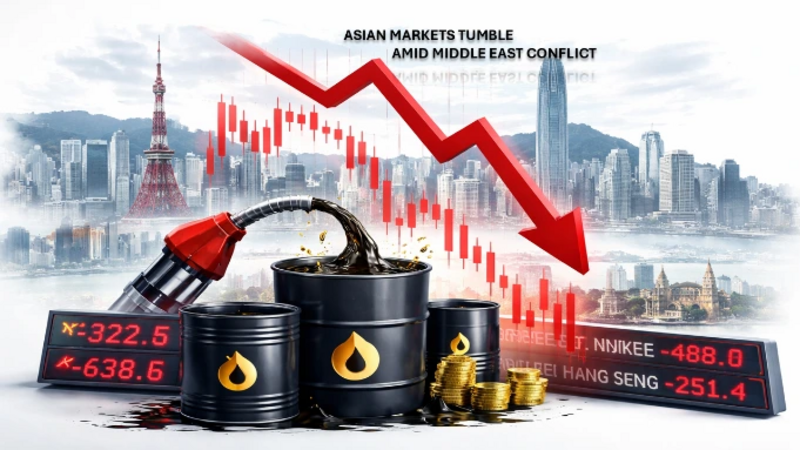
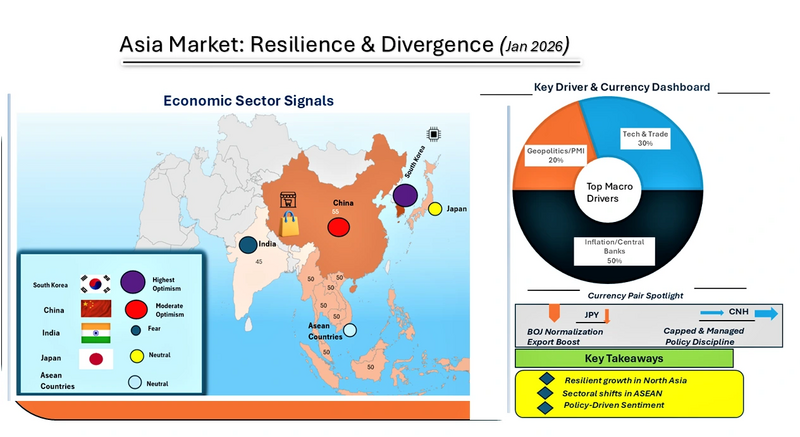
Asian Markets April 2026 performance and Q2 outlook - financial graphs showing oil shock impact versus AI driven resilience across regional economies. Image Credits Kenneth Njoroge | Kencrave
Asia Markets April 2026 Analysis: Oil Shock, Ai Resilience, And Q2 Investment Strategy
Asian markets in April 2026 experienced significant volatility, driven by a sharp oil price shock linked to Middle East tension followed by a strong AI-led technology rally. The month began with a risk-off sentiment as energy prices surged but ended with renewed optimism due to easing geopolitical concerns and strong semiconductor earnings led to increased investor confidence.
This shift highlights the growing influence of energy markets, artificial intelligence, and central bank policy on Asian equities, setting the stage for the Q2 2026 market outlook.
Asian Markets Performance Overview (April 2026)
Performance across major Asian indices was mixed but showed resilience.
Nikkei 225 (Japan): Gained approximately 12.6% for the month, ending at 60,537.36 after a late month driven by easing energy concerns and global risk‑on sentiment.
KOSPI (South Korea):Reached record highs in late April, climbing 2.1% in a single late-month session alone, driven by AI memory demand.
Hang Seng (Hong Kong): Rebounded at around 1.7% on April 30 following positive policy signals from Beijing supporting investor sentiments.
SET (Thailand): Remained a laggard, declining by an estimated 2.4% as it grappled with weak domestic momentum and inflationary pressures weighed on retail and consumer stocks.
MSCI Asia Index. The MSCI Asia Index performance experienced declines in both the first quarter of 2026 and the month ending April 2026, driven mainly by geopolitical tensions and surging oil prices. It fell about 1.1% in Q1 2026, with a sharp 13.7% drop in March, and continued to struggle in April lower from earlier highs.
Asia Q1 2026 Market Performance - MSCI Asia Index country and sector comparison showing Energy and Technology trends across South Korea, Taiwan, Thailand, Malaysia, Singapore, China, India, and Indonesia.
Overall, Asian stock markets showed resilience, with technology and energy sectors offsetting broader macro risks.
Key Events and Market Drivers of Asian Markets in April 2026
Oil Price Shock and Energy Market Volatility: The month was dominated by energy supply shock on record" as conflict effectively closed the Strait of Hormuz, a major supply route for oil (accounts for an estimated 40% global supply chain route). Brent crude surged to over $119.50 per barrel, creating massive stagflationary pressure.
AI and Semiconductor Earnings Super-cycle: Positive results from regional tech giants acted as a powerful counterweight to geopolitical risks. Samsung reported a 48x surge in profit for its chip unit, while TSMC saw a 58% jump in quarterly profit.
China’s Policy Support Measures on EVs and solar: Beijing intensified efforts to curb the price wars in sectors like EVs and solar, aiming to improve corporate profitability.
The Winners: Best-Performing Energy Stocks
Energy was a standout sector in April as oil prices spiked globally. Investors moved their funds into companies that could capitalize on high refining margins:
Thai Oil PCL (Thailand). The company closed the month of April 2026 as the best performing energy stock in Asia benefiting from the global supply chain disruptions.
China’s COSCO Shipping Energy: It benefited from Asia’s reliance on imported crude. Rising transport volumes and freight rates boosted the company’s earnings as net profits surged.
Sinopec Oilfield Service (YZCFF): The company was also one of the top performing companies in Asia’s energy sector due to increased drilling and oil exploration. However, it was outpaced by refiners and shippers (Thai Oil, COSCO) that benefited more directly from oil price volatility and transport demand.
Reliance Industries (India): This was a notable player in the energy sector which benefited from its integrated structure, allowing it to navigate price volatility. The board recommended a dividend of ₹6 per share for FY26 driven by net profit of ₹16,971 crore for Q4 FY26 against a net profit of ₹18,645 crore in the previous quarter and ₹19,407 crore a year earlier.This marked an increase in dividend payout from the previous year 2025 dividend of ₹5.50 per share.
The Losers: Asian Sectors and Stocks That Declined
Aviation and Logistics: High fuel costs directly squeezed margins for regional carriers. AirAsia and Cathay Pacific saw declines as jet fuel prices reached record highs. Airlines trimmed capacity, raised fares, and added refueling stops to cope with the high costs of fuel largely driven by disruptions of strait of Hormuz.
Indian IT: India's IT sector underperformed significantly. Despite posting a profit of ₹17,361 Crores (13.3% of revenue), down 0.2%, margins declined leading to a sharp sell-off. HCL Tech crashed 9% following the quarterly results that did not meet expectations. This was driven by a global decline for IT services majorly from North America and Europe. Further, a stronger rupee reduced export competitiveness, adding pressure to the IT sector in India.
Consumer & Retail (Thailand): Major retailers like CPAXT (CP Axtra) posted losses as inflationary pressures weakened spending by consumers. Inflation rose to about 2.9%, up from -0.1% in 2025 with core inflation at 1.6% as per the Bank of Thailand.
Asia sector performance timeline April 2026 showing energy and technology winners, aviation and retail losers.
Asia'sCentral Bank Responses
Asian central banks largely held a "wait-and-see" posture:
Bank of Japan (BoJ): Kept rates at 0.75%, despite few dissents in favor of a hike to 1.0% to combat oil-driven inflation. However, the Consumer Price Index (CPI) forecast was raised to 2.8% FY26.
Reserve Bank of India (RBI): Stood firm on rates by holding the repo rate at 5.25%, as the bank waits for the impact of high oil prices to settle before considering future adjustments. Inflation was estimated at 3.4%-3.8% for the month of April 2026, with GDP growth projections for FY27 at 6.9%.
Bank of Korea: The Bank of Korea maintained its base rate at 2.5%. Inflation was around 2.6% year‑on‑year, up from 2.2% in March. This marked the highest reading since December 2025 reflecting the impact of surging oil prices and energy supply disruptions. The global oil price shocks have necessitated the Bank of Korea to raise its full‑year inflation forecast to around 2.9%.
Bank Indonesia (BI): The benchmark interest rate unchanged at 4.75% in April 2026, marking the seventh consecutive hold. The decision was aimed at stabilizing the rupiah, which had weakened past 17,000 per USD due to Middle East conflict-driven oil shocks and capital outflows. Indonesia’s inflation at the end of April 2026 was 2.42% YoY and 0.13% MoM. This showed easing price pressures due to stable prices of food commodities supported by government subsidies to caution the economy against global oil shocks.
People’s Bank of China (PBoC): The PBoC kept its Loan Prime Rates unchanged at 3.00% (1‑year) and 3.50% (5‑year) in April 2026, maintaining a neutral stance while signaling possible easing later in the year to support growth. Unlike Korea or India, China’s inflation didn’t spike sharply despite Middle East disruptions. China’s CPI was low and stable around 1% at the end of April 2026. Low inflation gave China room to focus on supporting GDP growth rather than tightening policy like its Asian peers.
The policies adopted by the Asia’s Central Banks reflects a balanced approach between inflation control and growth support.
Investor Recommendations for Q2 2026
Sector Allocation
Favor Energy & Shipping: Oil price volatility and freight demand continue to support refiners, shippers, and logistics firms.
Favor Technology (Semiconductors & AI): Strong AI memory demand in Korea and Japan is likely to sustain momentum.
Be neutral on Financials: Banks benefit from stable rates but they could potentially face margin pressure if oil shocks persist.
Be cautious on Aviation & Retail: Airlines remain squeezed by jet fuel costs; retail in Thailand and parts of Asia faces weak consumer spending.
Your Tactical Moves
Japan (Nikkei 225): Momentum play, record highs suggest continued upside but watch for profit‑taking.
South Korea (KOSPI): Semiconductor demand is structural thus maintain exposure.
Hong Kong (Hang Seng): Policy easing signals from Beijing support an economic rebound; focus on selective entry in property and tech.
Thailand (sSET): Avoid or reduce exposure to consumer/retail and instead focus on energy exporters.
Key Risks to Asian Markets in 2026
While there are several entries into the Asian market, investors to monitor:
Oil price shocks from a renewed Middle East conflict.
Currency volatility (won, rupiah, baht).
Inflation emerging in Asian economies.
Policy Recommendations for Governments & Stakeholders
Short‑Term (Q2 2026)
Energy Security: Diversify oil import sources and accelerate towards establishing strategic reserves.
Targeted Subsidies: Maintain fuel subsidies and household support to cushion citizens from inflation without distorting markets.
Currency Stabilization: Central banks should continue FX interventions to prevent imported inflation.
Medium‑Term (2026-2027)
Tech Investment: Support semiconductor and AI industries through R&D incentives. These are key growth drivers in Japan and Korea.
Consumer Relief: Thailand should consider targeted tax breaks or cash transfers to revive retail demand.
Regional Coordination: Enhance regional coordination on oil shock responses to avoid fragmented policies that impact negatively the region.
However, note that these scenarios could change, due to evolving oil prices and geopolitical developments requiring a scenario-based approach.
Investor and Policy Scenario Analysis for May & Q2 2026
Asia market and policy scenario analysis Q2 2026 showing oil price paths, investor strategies, government responses.
Asia Markets at a Turning Point
Asia markets in April 2026 demonstrated resilience amid volatility, with energy shocks and AI-driven growth shaping market direction.
Looking ahead, Q2 2026 is likely to favor energy and technology sectors, but investors must remain cautious of geopolitical risks, inflation pressures, and currency instability.
A balanced, sector-focused investment strategy will be critical to navigating the evolving Asian market landscape.
Key Takeaways
Asian markets in April 2026 shifted from a geopolitical-driven selloff to a tech-led rebound, highlighting resilience amid volatility.
Energy and shipping stocks outperformed as oil price spikes boosted margins and transport demand.
AI-driven semiconductor demand powered strong gains in Korea and Japan, reinforcing tech as a structural growth driver.
Aviation, retail, and parts of IT underperformed due to high fuel costs, weak consumer demand, and global slowdown pressures.
The Q2 outlook favors energy and technology sectors, but remains vulnerable to oil shocks, inflation, and currency volatility.
FAQS: Asia Markets Outlook Q2
1. What drove Asian markets in April 2026?
Asian markets were driven by a mix of oil price shocks from Middle East tensions and a late-month AI-led tech rally, which shifted sentiment from risk-off to risk-on.
2. Which sectors performed best in Asia in April 2026?
Energy and technology (especially semiconductors and AI) outperformed, supported by rising oil prices and strong earnings from major chipmakers.
3. Which sectors underperformed in Asian markets?
Aviation, retail, and parts of IT services lagged due to high fuel costs, weak consumer demand, and pressure on global tech spending.
4. How did central banks in Asia respond to market conditions?
Most central banks, including those in Japan, India, and South Korea, held interest rates steady while monitoring inflation driven by energy prices.
5. What is the outlook for Asian markets in Q2 2026?
The outlook favors energy and AI-driven tech sectors, while risks include oil price volatility, currency fluctuations, and rising inflation across key economies.
Asian stock markets fell sharply in the week ending March 13, 2026, as escalating tensions in the Middle East triggered a surge in oil prices and renewed fears of persistent...
Asia Market Outlook Summary (Q1 2026)
Asia Market Outlook 2026 points to a cautiously risk-on environment in early Q1, supported by easing inflation, resilient exports, and policy-managed stability across China,...