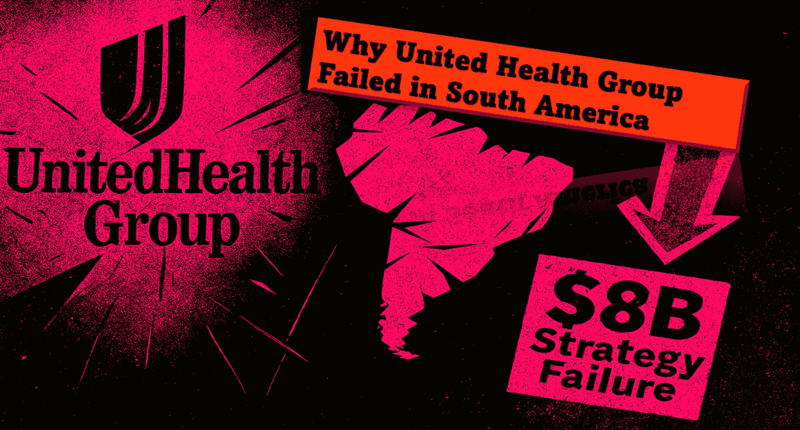
UnitedHealth Group’s (UHG) costly exit from South America marks a decisive strategic pivot from global ambition to domestic fortification. Triggered by over $8 billion in cumulative losses, relentless regulatory scandals in Brazil, and mounting pressures on its core U.S. business, the retreat underscores the fatal mismatch between a capital-intensive, vertically integrated U.S. model and the volatile realities of emerging markets. This analysis details the exit’s drivers, contrasts UHG’s failed approach with the adaptive strategies of peers, and outlines the resulting shift toward asset-light, partnership-driven investment in global healthcare.
THE FINANCIAL CATASTROPHE: $8 BILLION IN LOSSES EXPLAINED
UnitedHealth Group (UHG) announced its intention to exit South America in phases beginning late 2022 following a strategic review of its international operations. The withdrawal was not abrupt; it unfolded over several years through asset sales and restructuring. As of November 30, 2025, UnitedHealth Group agreed to sell its last South American business, Banmedica, which operated primarily in Chile and Colombia, to Brazilian private equity group Patria Investments for $1 billion. Reuters
Banmedica is a major health insurer that also runs hospitals and medical centers, with around 1.7 million health insurance members, 7 hospitals and 47 medical centers acrossChile and Colombia.
REASONS FOR LEAVING SOUTH AMERICA AND WHY THE EXIT TOOK SO LONG
UHG sought to refocus on its core U.S. Business strategically.
The non-core markets provide constant operational barriers due to complex local regulations, political and economic volatility (especially in Brazil), currency exchange risks, and fierce competition from well-established local players.
Rising medical cost trends and operational pressures at Optum and other units in the U.S. Due to margin pressure from inflation, labor shortages and elevated medical utilization post-pandemic.
Leadership turnover, including a CEO change that looks to streamline operations, simplify the corporate structure and focus on the most critical growth and stability levers.
In February 2024, UnitedHealth Group suffered a major cyberattack on its Change Healthcare unit after attackers exploited compromised login credentials on a remote access portal that lacked multi-factor authentication. The breach led to widespread system shutdowns, disrupting the largest medical billing and claims processor in the U.S. healthcare system. This accelerated the strategic imperative to simplify operations, reduce peripheral risk exposure, and concentrate capital and leadership attention on the core U.S. market (Change Healthcare).
Why the Exit Took So Long: The Problem with "Hard" Assets
UHG couldn't leave South America quickly because of the very strategy that failed: investing in "hard" assets like hospitals and insurance companies.
Hard to Sell: You can't sell a network of hospitals and clinics as easily as you can sell an app or a service. Finding a buyer with enough money and the right government approvals takes a long time.
Governments Were Watching: Healthcare is a sensitive public service. Governments in Chile, Colombia, and Brazil closely watched the sale to make sure patient care wouldn't be disrupted, which slowed everything down.
They Needed a Responsible Buyer: UHG wanted to sell to a company that could keep the hospitals and clinics running well. This limited their options and made negotiations longer.
A Quick Sale Would Have Cost More: If UHG had rushed to sell, they would have had to accept much lower prices, losing even more money.
Bottom Line:UHG's big investments in physical assets locked them in. When they decided to leave, they were stuck in a slow, expensive, and very public exit process. This is a major risk of the "hard capital" model.
How the Cyberattack Sped Up the Exit
The massive cyberattack on UHG's U.S. business in 2024, targeting its subsidiary, Change Healthcare, becameone of the largest healthcare data breaches in U.S. history. It didn't just cause a mess; it forced the company to make a fast, hard choice about its priorities.
It showed UHG was Vulnerable at home: The attack proved that UHG's core U.S. business was not as secure as they thought. Fixing this huge problem required the attention and resources of the entire management team.
"Protect America First" Became the Rule: After the attack, the only mission was to protect and strengthen the main U.S. business. Struggling operations in South America suddenly looked like a dangerous distraction.
Money Had to Move Fast: The attack cost billions to fix. UHG could no longer afford to spend money propping up its South American losses. That cash was now needed at home.
A Decision Became an Emergency: Leaving South America went from being a "smart strategic move" to an "urgent necessity." The cyberattack made the company's leadership act faster to get out.
Bottom Line:The cyberattack was a wake-up call. It made UHG realize it was spread too thin. Protecting its home base became the only thing that mattered, which meant getting out of South America as soon as possible.
Why the exit is notable
UnitedHealth Group is the largest health insurer in the world, and its withdrawal represents a rare retreat by a global healthcare giant.
The company exited at a substantial financial loss, estimated at over $8 billion in cumulative write-downs.
The exit highlights the difficulty of exporting a U.S.-style, vertically integrated healthcare model into politically sensitive and highly regulated emerging markets.
UNITEDHEALTH GROUP’S HISTORY IN SOUTH AMERICA: ENTRY AND EXPANSION
United Healthcare South America timeline: Brazil entry (2012), Banmédica acquisition (2018), regulatory challenges, strategic retreat, final exit (2025). Source: IPMI Global
UnitedHealth Group’s expansion coincided with a window of regulatory permissiveness that closed permanently after governance failures.
DECODING SUCCESS: THE ADAPTIVE PLAYBOOKS OF BUPA, AETNA, AXA, AND ALLIANZ.
UnitedHealth Group’s exit prompted a cautious reassessment among global healthcare firms. Most did not exit South America, but adjusted their strategies. Global insurers increasingly favor partnerships, joint ventures or insurance-only models.
1. Aetna / CVS Health(U.S)
It is U.S.-centric but has selective international exposure via services, but not ownership.
Contrast: avoids the regulatory and political risk UHG struggled with.
2. Bupa (UK).
Operates under a long-term, slow-growth model and accepts thinner margins in exchange for regional stability.
Contrast: Bupa is patient; UHG wanted scale and faster returns.
3. Axa (France)
Reduced exposure but did not fully exit. Pivoted to partnerships and reinsurance rather than retail health insurance.
Contrast: risk-sharing instead of full ownership.
4. Allianz (Germany)
Focuses on corporate health and specialty insurance.
Contrast: avoids mass market retail and is less exposed to political backlash over pricing and coverage.
Comparative chart of UnitedHealth Group model assumptions versus emerging market realities, highlighting scale, vertical integration, capital strength, and growth challenges.
COMPETITIVE VIEW: THE LOCAL CHAMPIONS THAT UNITED HEALTH GROUP COULD NOT DISPLACE
While UHG struggled, several well-entrenched local and regional players demonstrated how to succeed in South America's complex healthcare markets. Their success underscores the critical strategic missteps of the UHG approach.
1. Hapvida NotreDame Intermédica (HNDI)
Model: Hyper-localized vertical integration Why They Succeeded
Geographic Concentration: HNDI built dense, regional networks
Cost Control through Ownership: By owning hospitals, clinics, and labs, they control the entire care chain, reducing leakage and managing medical costs more effectively
2. Bradesco Saúde /OdontoPrev
Model: Financial-Health Conglomerate Synergy leveraging Brazil's largest private banking network. Why They Succeeded:
Cross-selling Ecosystem: Integrates health insurance with banking products, payroll services, and corporate benefits creating high customer stickiness
Local Regulatory Mastery: Deep, long-standing relationships with Brazilian regulators allow for more predictable navigation of policy changes.
3. Grupo de Empresas (Chile) / Keralty (Colombia)
Model: Cooperative & Social Enterprise with strong community embeddedness. Why They Succeeded:
Mission Alignment over Pure Profit. It was structured as non-profits/ cooperative.
Lower Capital Costs: As member-owned or socially-focused entities, they can operate with thinner margins and reinvest surpluses
Community-Based Care Networks: They built grassroots provider networks aligned with local practice patterns
4. Fresenius Medical Care
Model: Specialized, Niche Dominance in renal care and dialysis services. Why They Succeeded (as a multinational contrast to UHG):
Focused Expertise. Instead of tackling the entire healthcare system, they dominate a single, high-need clinical segment where they can be the undisputed quality and cost leader.
Government Partnership Focus: Much of their business comes from public sector
Comparative table of UnitedHealth Group vs South America local champions showing ownership, regulatory ties, cost structure, and time horizon.
EXPECTED CHANGES FROM THE SALE AND MARKET IMPACT
Short-term effects
Minimal disruption for patients.
Continuity of services under new ownership.
Existing insurance contracts remain valid.
Medium- to long-term effects
Increased cost discipline under private equity ownership.
Possible restructuring of hospital networks.
Gradual pricing adjustments and tighter claims management.
Greater emphasis on efficiency and profitability.
WHY UNITEDHEALTH GROUP FAILED IN SOUTH AMERICA
UHG’s failure was not operational incompetence, but strategic overconfidence, assuming that scale, capital strength and vertical integration would translate seamlessly across borders. In South America, success favored local legitimacy, regulatory intimacy, cost discipline and long-term patience, areas where domestic competitors held decisive advantages.
1. Capital-Heavy, Highly Visible Model
UHG invested heavily in owned hospitals, clinics, and insurance balance sheets, most notably through Amil (Brazil) and Banmédica (Chile/Colombia). These assets required large upfront capital, long payback periods, and continuous reinvestment. Owning hospitals made UHG politically and regulatorily exposed, especially during pricing disputes or capacity shortages.
2. Healthcare Is Deeply Political in South America
Healthcare pricing, coverage, and service quality are treated as social and political issues, not purely commercial ones. Governments intervene aggressively when public dissatisfaction rises. Following the 2016 Amil corruption scandal in Brazil, regulators intensified scrutiny of private insurers. UHG, as a foreign multinational, became an easy political target.
3. Underestimated Currency and Macroeconomic Risk
UHG generated revenues in volatile local currencies while reporting earnings in U.S. dollars, exposing returns to persistent depreciation and inflation shocks.
4. Lack of Patience for Slower, Lower-Margin Growth
Emerging market healthcare rewards long-term presence, incremental expansion, and operational discipline, not rapid scaling or short-cycle returns. UHG sought scale efficiencies similar to its U.S. operations, expecting margins that were unrealistic in price-sensitive markets.
5. Fragmented and Unpredictable Regulatory Environments
South America is not a single regulatory market. Each country and region has distinct rules on pricing, coverage, ownership and capital requirements.UHG faced different regulatory regimes in Brazil, Chile, and Colombia, complicating compliance, governance, and strategic coordination.
Bar chart of UHG regulatory intensity in Brazil from 2012 to 2022, showing spikes in 2016 and 2021.
Key Insights:
Before 2016, there weremanageable regulations, thus business can operate effectively. After the 2016 scandal, the police raided Amil's offices, and executives were arrested for corruption, resulting in massive reputation damage and legal costs. The regulatory pressure did not fully recover, and in 2021 during COVID, the government increased intensity when cracking down on all health insurers.
Map of South America showing regulatory challenges in Brazil, Chile, and Colombia with flags and risk levels.
IMPLICATIONS FOR INVESTMENT IN EMERGING MARKETS
Global capital is becoming more selective due to:
Higher global interest rates.
Reduced tolerance for political and regulatory risk.
Increased focus on liquidity and exit flexibility.
This has resulted in investors prioritizing:
Asset-light models.
Clear exit paths.
Local partnerships.
Revenue diversification across markets.
Lower exposure to political decision-making.
Why local investment is increasing for Local and regional investors:
Better understand regulatory environments.
Face lower currency mismatch.
Have stronger political and institutional relationships.
Are more willing to accept long-term, moderate returns
HARD VS SOFT CAPITAL: THE NEW HEALTHCARE INVESTMENT PARADIGM
UnitedHealth Group’s model
UnitedHealth Group bet on physical hospitals, insurance balance sheets, and local currency. This is hard capitalwhich is illiquid, politically visible, slow to exit and margin-sensitive.
A chart showing UHG $8B capital loss with investment, asset sales, net destruction, and write-downs
Based on UnitedHealth Group's disclosed $7.7B in total South American investments(cumulative investment in Amil (Brazil, 2012) and Banmédica (Chile, 2018)) and estimated total sale proceeds of approximately $2.8B, the company recovered only about 36% of its initial capital. This calculation aligns with the estimated 8 billion in cumulative write-downs UHG reported on these assets in its SEC filings( UHG NEWSROOM(AMIL), UHG bancmedica).
By contrast, telemedicine and AI startups operate on asset-light platforms, software & data, making regional scalability and exits through acquisitions, shutdowns, and pivots easier.
This is soft capital. It is mobile, modular, easier to scale down or up, and less exposed to regulators initially.
STRATEGIC GUIDE: HOW TO INVEST IN EMERGING MARKET HEALTHCARE POST-UNITEDHEALTH GROUP
For multinational healthcare firms
Avoid full vertical integration in emerging markets.
Use partnerships or minority stakes.
Price political and currency risk explicitly.
Align operating models with local systems.
For policymakers
Improve regulatory clarity and predictability.
Encourage responsible foreign participation without excessive complexity.
Support digital and preventative healthcare innovation.
For investors
Favor hybrid models combining local ownership with global expertise.
Focus on digital health, telemedicine, and insurtech.
Treat healthcare as a long-term social investment, not a rapid-return asset.
Strategic pyramid of emerging market investment playbook showing asset-light models, partnerships, and regulatory risk pricing.
Bottom Line
UnitedHealth Group’s exit from South America marks a turning point in global healthcare investment strategy. It illustrates the limits of exporting large-scale, U.S. Healthcare models into emerging markets and reinforces the growing importance of local capital, adaptive strategies and flexible investment structures.
FAQ’s: UnitedHealth Group Failure in South America
1. Why did UnitedHealth Group fail in South America
UHG’s capital-heavy, vertically integrated U.S. healthcare model conflicted with regulations, political oversight, currency volatility, and lower-margin emerging market healthcare systems.
2. How much did UnitedHealth Group lose in South America?
UHG incurred over $8 billion in losses, recovering only an estimated 36% of invested capital after divesting its South American operations.
3. When did UnitedHealth Group exit South America?
The phased exit began in late 2022 and was completed in 2025 with the sale of Banmédica in Chile and Colombia.
4. Why did other global insurers succeed?
They used asset-light, partnership-based strategies, reducing capital intensity, regulatory exposure, and political risk.
5.What does this exit mean for emerging market healthcare investment?
It signals a shift toward local partnerships, flexible investment structures, and digital-first healthcare solutions.
Renewable Energy, Green Financing, and Market Impact in South America
Executive Summary
South America is rapidly emerging as one of the world’s fastest-growing data center markets. Once overshadowed by established...
Illegal mining in the Amazon is more than an environmental problem; it’s a multi-dimensional crisis affecting people, economies, and ecosystems. In December 2023, a joint Colombian Brazilian task force destroyed...