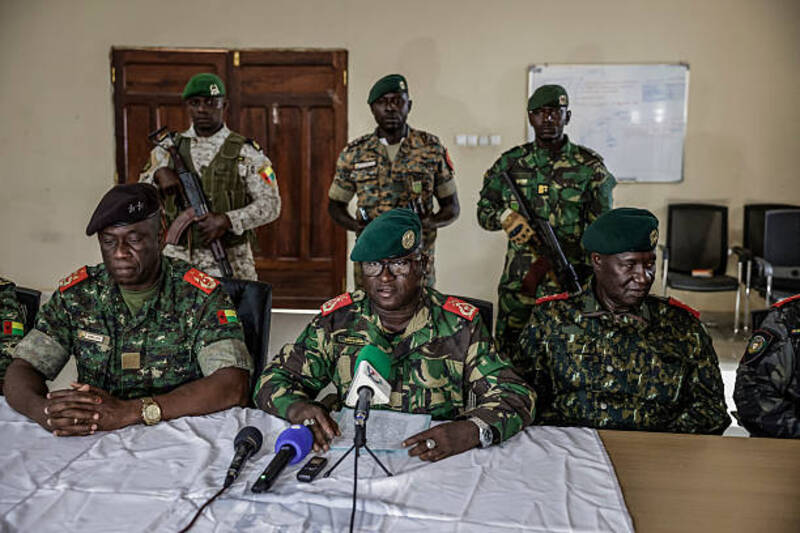
November 2025, Guinea-Bissau military coup and its regional impact on West African democracy with soldiers securing the presidential palace in Bissau. Image Credits: Getty Images
The 2025 Guinea Bissau Coup: Causes, Regional Fallout, And The Future Of West Africa's Democracy
The 2025 Guinea-Bissau coup, triggered by disputed elections and weak institutions, underscores the country’s chronic political instability. The military takeover has immediate socio-economic consequences and challenges regional governance. ECOWAS and international actors condemned the coup, highlighting broader threats to West African democracy and stability.
Overview of November 2025, Guinea-Bissau's Coup
As of27 November 2025, Guinea-Bissau remained tense and uncertain after a group of army officers announced that they had seized power. The military suspended ongoing electoral process, closed all borders, and imposed an indefinite night curfew.
General elections, both presidential and legislative, were held on 23 November 2025. Almost immediately after voting ended, President Umaro Sissoco Embaló and his main challenger, Fernando Dias, both claimed victory. With no provisional results released and political mistrust running high, tension escalated rapidly.
On26 November,the eve of the expected results announcement, heavy gunfire erupted near key state institutions, including the presidential palace, the national electoral commission headquarters, and the interior ministry. Witnesses reported armed men, some in military uniform, taking strategic positions across the capital. Telecommunications were disrupted as panic spread among civilians (Aljazeera, 2025).
Why Guinea-Bissau's 2025 Coup was successful
The takeover unfolded swiftly due to several structural vulnerabilities:
Historical Instability: Guinea-Bissau’s long-standing coup culture and institutional fragility created fertile ground for military intervention.
Control of Strategic Assets: Reports indicate that high-ranking officers involved in the coup already commanded key military units and critical infrastructure.
Institutional Vacuum:With parliament dissolved and both major candidates claiming victory, no credible civilian authority was positioned to resist the takeover.
Why instability is persistent in Guinea-Bissau
Since independence in 1973, Guinea-Bissau has struggled to maintain stable governance. Until recently, no president had completed a full term peacefully. Chronic instability has been driven by:
Military factions competing for influence.
Entrenched drug-trafficking networks.
Weak state institutions.
Fragmented political parties.
Personalized political rivalry.
These factors repeatedly undermine democratic consolidation.
Timeline of political instability and military interventions in Guinea-Bissau from 1980 to 2025, highlighting coups, mutinies, and election disputes.
Social economic context and implications
Guinea-Bissau is among the least developed countries in the world. The economy is heavily dependent on cashew nuts export (90%) and foreign aid.
Guinea Bissau's Key Economic Indicators:
GDP (nominal): est. USD 2.1 billion (2024); est. USD 2.23 billion (2025).
GDP per capita: est. USD 1,100–1,200 (one of the lowest in West Africa).
Human Development Index (HDI): 0.514 (UNDP, 2023).
Literacy rate: 60–65%.
Electricity access: 30–40%.
Life expectancy: 60–62 years.
Maternal mortality: est. 550 per 100,000.
Infant mortality: 80–90 per 1,000.
Poverty rate: est. 60%.
Bar chart comparing GDP, HDI, and political stability of Guinea-Bissau with Senegal, Guinea, Mali, and Burkina Faso in West Africa.
Key Insights from Bar Chart
Senegal leads in all three metrics: GDP, Human Development Index (HDI), and political stability, indicating stronger socio-economic performance.
Guinea-Bissau ranks lowest across all indicators, reflecting developmental and governance challenges.
Guinea, Mali, and Burkina Faso show moderate GDP but struggle with HDI and political stability, suggesting uneven progress.
Political stability correlates strongly with development outcomes, evident in more stable states like Senegal.
International condemnation: How ECOWAS, UN and Global Powers Responded
The international community has condemned the military takeover:
ECOWAS, AU, and WAEF denounced the coup as an attempt to derail a peaceful electoral process. They demanded the release of detained officials and the resumption of vote counting.
The UN Secretary-General called for restraint and adherence to constitutional order.
The Government of Ghana labeled the coup a “direct assault on democracy,” urging swift restoration of civilian rule.
Qatar called for de-escalation and constitutional governance.
Portugal, Guinea-Bissau’s former colonial power, urged all parties to avoid violence and allow the electoral process to conclude.
The effectiveness of such external pressures remains uncertain for Guinea-Bissau's political maturity.
Immediate Implications: Paralysis, sanctions, and deepening crisis for Guinea-Bissau
Democratic Backsliding: Interrupting an election severely erodes public confidence in democratic processes.
Institutional Paralysis: With parliament dissolved and officials detained, governance has stalled.
Sanction Risks: Suspension from ECOWAS and targeted sanctions.
Loss of Investor Confidence: Lack of Investment flows to the country will likely shrink Guinea-Bissau's economy.
Aid Disruptions: Possible suspension from the IMF, World Bank, Portugal, and UN agencies.
Economic Deterioration: Border closures may worsen inflation, disrupt trade, and create opportunities for drug networks and black-market activities.
Geopolitical winners and losers: Shifting Alliances in West Africa
Foreign powers see an opportunity to protect interests, expand influence or signal support.
France dominates West Africa’s diplomacy, security cooperation, and regional trade. French companies or NGOs may face operational disruption
Russia. Juntas in Mali, Burkina Faso, and Niger have relied on Russian security advisors or logistics support through arm sales.
Gulf States (Qatar, UAE, Saudi Arabia). Gulf states invest in West African infrastructure, ports and energy projects. They fund local media, mosques and charities. They can provide financial or political support to a regime if it aligns with their interests.
West Africa's Coup epidemic crisis in context
The global number for attempted coups is approximately 492 since 1950, with 220 being from Africa,109 of them being successful, and 111 being unsuccessful (VOA, coups in Africa).
45 of the 54 nations across Africa have experienced at least a single coup attempt since 1950. Conversely, there have been no successful coups in richer African countries with strong institutions, such as South Africa and Botswana. West Africa accounts account for more than half of coups in Africa. Sahel, central, east, south and north Africa follow suite respectively.
The frequent coups in West Africa are attributed to:
Colonial legacies and weak institutions. Weak institutions and colonial-era divisions normalized military intervention.
Fragile democracies and disputed elections. Elections and checks on power are often weak or disputed.
Poverty and unemployment. Poverty, unemployment, and corruption fuel dissatisfaction.
Military dominance in politics. Organized militaries see themselves as guardians of the state.
Ethnic and regional divides. Power struggles along ethnic lines create tensions.
External interference and foreign funding. Foreign powers and funding can destabilize governments.
Pie chart showing regional distribution of successful coups in Africa from 1950 to 2023, highlighting West Africa as the most affected region.
Key Insights from Pie Chart
West Africa accounts for 52% of all successful coups in Africa, making it the most politically unstable region historically.
Central Africa follows with 20%, while East Africa has 18%.
Southern Africa and North Africa show significantly lower coup activity at 6% and 4%, respectively.
Case Studies: Niger's transition Vs Kenya's Power Sharing Model
Niger (2010): A military coup eventually led to elections within a year and a return to civilian rule, demonstrating that juntas can, under pressure, transition back to democracy.
Kenya (2007): Electoral violence and political crisis were resolved through mediation and power-sharing,not military intervention, showing how political negotiation can avert conflict.
ECOWAS dilemma: Erosion of authority and path forward
Recent coups in Guinea-Bissau (2025), Niger (2023), Mali (2020 & 2021) and Burkina Faso (2022 & 2023), show that military takeovers are still a persistent problem in West Africa.
This has put ECOWAS on the spot with each new coup testing its enforcement mechanisms like sanctions, mediation or military intervention. Countries like Burkina Faso and Mali have resisted ECOWAS’ interventions in the past, seeking alliances outside the region.
ECOWAS must adapt by:
Strengthening mediation mechanisms.
Enhancing early warning and monitoring systems.
Reinforcing military professionalism and conduct protocols.
Coordinating more effectively with the AU and UN.
Pathways forward for Guinea-Bissau and the region
For Guinea-Bissau:
Strengthen democratic institutions and ensure transparent elections.
Clarify constitutional limits to prevent military interference.
Expand political dialogue and national reconciliation.
Address socio-economic challenges: poverty, unemployment, and corruption.
Implement long-term economic reforms and improve public financial management.
For West Africa:
Invest in governance reform.
Support civil society and independent electoral bodies.
Build resilient state institutions free from military influence.
Key Takeaways from the 2025 Guinea-Bissau Coup: Causes, Impacts, and Regional Implications
The 2025 Guinea-Bissau coup was triggered by disputed election results and weak institutions.
Chronic instability stems from military dominance, criminal networks, and fragmented politics.
The economy faces immediate risks: aid suspension, investor withdrawal, and inflation.
ECOWAS and the international community condemned the coup but have limited leverage.
The event highlights a wider trend of democratic erosion in West Africa.
Frequently Asked Questions: Guinea-Bissau coup
1. Why did the 2025 Guinea-Bissau coup happen?
Because of disputed election results, weak institutions, military influence, and historical instability.
2. How does the coup affect West Africa?
It weakens regional stability, challenges ECOWAS authority, and contributes to West Africa’s growing coup epidemic.
3. What are the economic implications for Guinea-Bissau?
Executive Summary
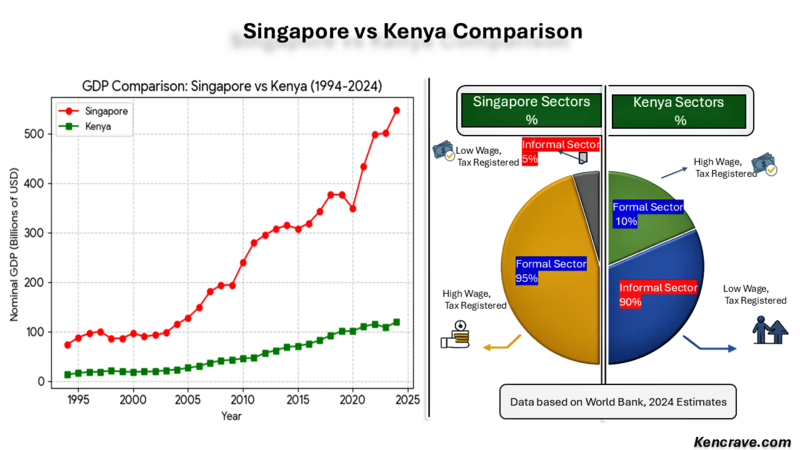
Kenya and Singapore started at the same GDP in 1963. By 2023, Singapore reached $500B; Kenya stayed at $113B. The difference is not resources, t's institutions that outlast...
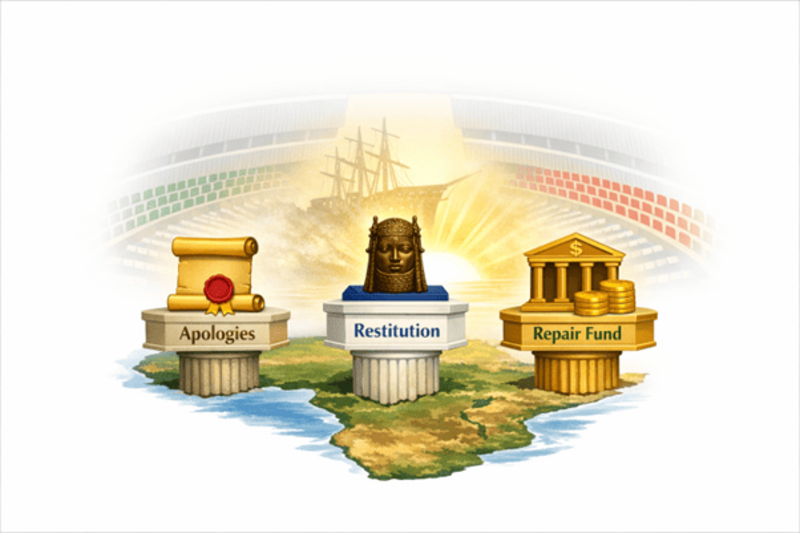
On March 25, 2026, the UN General Assembly adopted Resolution A/80/L.48, introduced by Ghana, marking a historic moment in the global reckoning with slavery. The resolution formally recognizes the transatlantic...
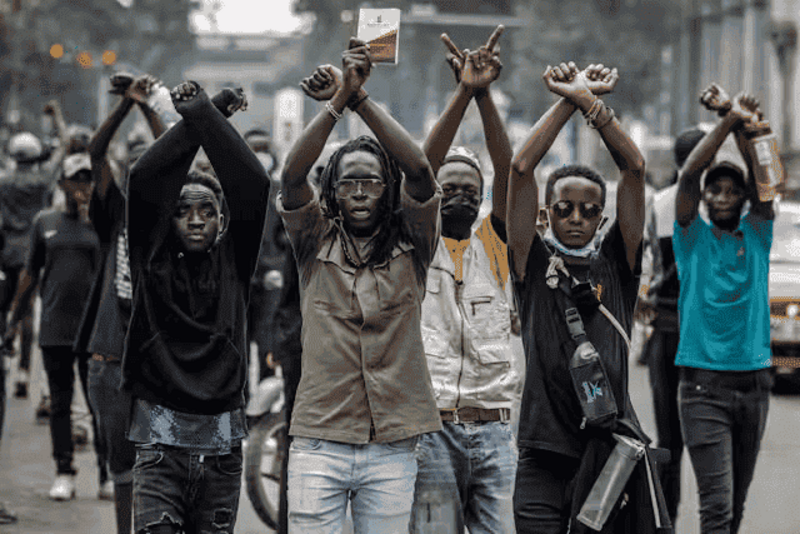
What began as a digital protest against Kenya’s Finance Bill 2024 tax hike in Nairobi, has evolved into a transnational youth movement challenging corruption, dynastic politics, and digital repression. The...
%20(2).png)
.png)
.png)