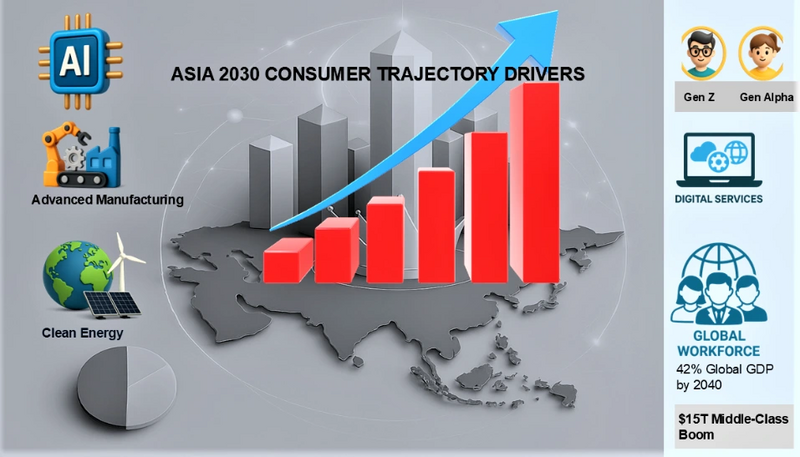
Asia 2030 consumer growth drivers with AI manufacturing, clean energy, Gen Z, digital services, global workforce, middle-class boom as the leading factors. Image Credits: Kencrave
Asia's $15 Trillion Middle Class Boom By 2030: Consumer Trends, Growth Markets And Winning Strategies
Asia is entering a new phase of economic transformation, driven by decades of export-led growth, market liberalization, and human capital development. Through reforms that promoted exports, opened markets, and built skilled human capital, the region moved from low-income to middle-income status. Asia is the home to the world’s largest and fastest-growing middle-class consumer base, shaping global demand, investment strategies, and digital innovation. Understanding how this shift began, and where it is headed remains key to capturing the $15 trillion Asia consumption opportunity emerging by 2030, (Private Wealth Management Association).
Asia’s Reform-Driven Rise and the New Consumer Landscape
Asia’s transformation was the result of economic reforms, export-oriented policies, and integration into global supply chains.
China’s Dual Track Strategy
China’s rise was anchored by the dual-track reform strategy, including the Household Responsibility System (1978), which increased rural incomes and food production. Gradual market liberalization encouraged competition in exports and light industries such as textiles, electronics manufacturing, and food processing (Center for International Knowledge on Development, 2020). Pro-investment policies opened doors to foreign multinationals and supported large-scale infrastructure investment in transport, telecommunications, and education—building the world’s largest manufacturing workforce.
The Four Asian Tigers
Hong Kong, South Korea, Singapore, and Taiwan executed rapid export-led growth.
Singapore’s Economic Development Boardattracted foreign industries and innovation centers.
South Korea invested heavily in heavy and chemical industries, later liberalizing finance and advancing technology.
All four economies invested in education to align skills with labor market needs and productivity gains.
ASEAN Economies
Indonesia, Vietnam, and the Philippines adopted trade openness, private investment promotion, and financial inclusion to support the rising ASEAN middle class.
In 2024, Foreign Direct Investment (FDI) remained a major driver of Asia’s economic growth, strengthening industrialization, technology adoption, and the expansion of the Asian middle class. China, the Four Asian Tigers, and Southeast Asian economies leveraged FDI inflows to modernize industries and accelerate their integration into global value chains, setting the stage for Asia’s second consumption wave.
These reforms shared a common theme: market-based systems, open trade, and investment in education and infrastructure. This boosted productivity, created millions of jobs, and lifted people out of poverty into a growing middle-class consumer market.
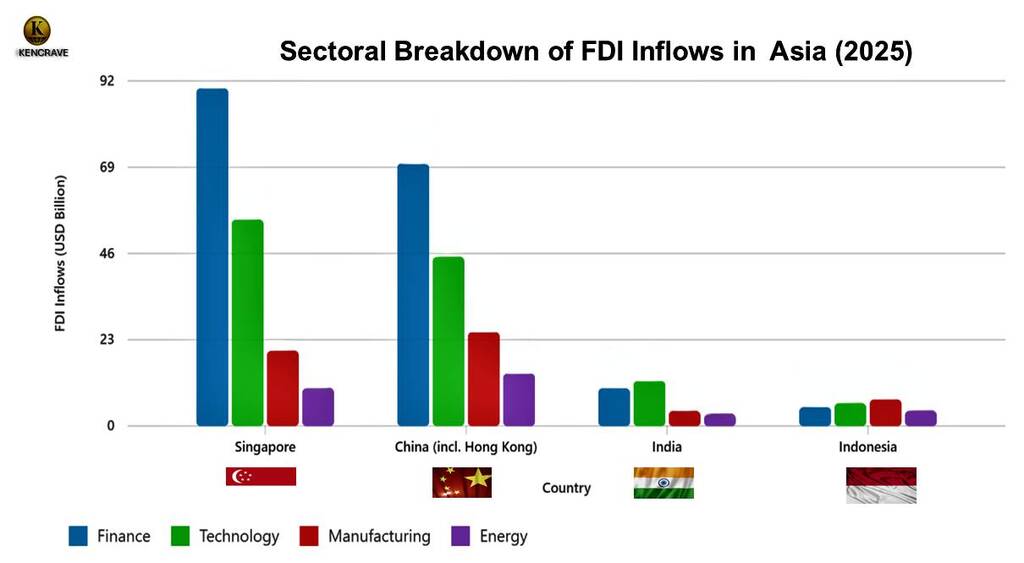
2025 FDI inflows by sector in Asia in Finance, Technology, Manufacturing, Energy across Singapore, China, India, Indonesia.
Key Insights from the graph: FDI Inflows by Sector in Asia (2025)
Singapore dominates Finance FDI (est. $92B), reinforcing its role as Asia’s financial hub.
China (incl. Hong Kong) attracts strong investment in both Finance and Technology, showcasing its dual strength in capital and innovation.
India’s FDI is tech-focused, while Indonesia shows balanced inflows, suggesting diversified sectoral appeal.
Implications: Investors prioritize financial and tech sectors in developed markets, while emerging economies attract broader interest.
By 2025, Asia’s growth drivers shifted toward digital adoption, consumer behavior, and sustainability-driven consumption. Today’s Asian middle class is connected, diverse, and values-driven, making it one of the world’s most complex and influential consumer segments. Updated 2030 projections highlight how businesses can position themselves within the $15 trillion Asian consumer market.
Asia’s 2030 Middle-Class Blueprint: The $15 Trillion Opportunity
Forecasts indicate that Asian consumer spending will exceed $15 trillion by 2030.
A 3.5 Billion-Person Middle Class
The World Economic Forum expects the global middle class to reach 5.5 billion by 2030, with Asia accounting for over 3.5 billion, making it the world’s epicenter of consumption (World Economic Forum).
Emerging Growth Hubs
While China remains a major market, Southeast Asian economies such as Vietnam, Indonesia, and the Philippines, among the fastest-growing emerging consumption hubs.
Asian consumers are evolving beyond traditional “premium” preferences toward:
Sustainability-driven consumption.
Digital-first shopping.
Frictionless commerce powered by super apps and integrated payment systems
Sustainability and Frictionless Commerce: The New Consumer Drivers
The Sustainability Imperative
Over 65% of urban Asian consumers under 40 identify as conscious consumers, seeking eco-friendly, traceable, and ethical products. Sustainability has shifted from niche to mainstream as consumers expect recycling, carbon neutrality, and traceability.
Frictionless Shopping
Asian markets are undergoing a transformation towards contextual commerce, where consumers can discover, purchase, and receive products instantly. The super app ecosystem continues to evolve into an integrated digital commerce infrastructure.
Untapped Markets: Gen Z Alpha and the Silver Economy
Gen Alpha: The Phygital Natives
Born after 2010, Gen Alpha represents Asia’s first true digital natives. They move seamlessly between digital and physical (“phygital”) experiences, adopt virtual identities, and expect AI-driven personalization and immersive commerce.
The Silver Economy
Asia’s population of individuals aged 60 years and above is projected to exceed 1.3 billion by 2050, creating a booming Silver Economy across:
Wellness tourism.
Smart living solutions.
Health technology.
Retirement fintech.
Assisted living.
Japan, Hong Kong, and South Korea lead in aging demographics, while China, Thailand, and Armenia are entering mid-stage transitions. Indonesia, India, and Bangladesh will experience accelerating aging through the next decade.
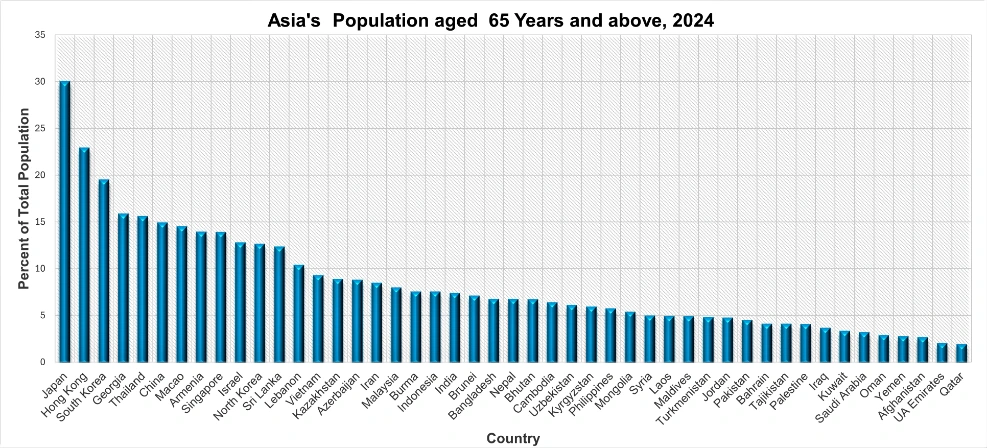
The chart below shows the percentage of the population aged 65 and above across Asia in 2024. Source: The Global Economy
2024 bar chart showing the percentage of the population aged 65+ years across Asian countries, led by Japan.
Key insights from the graph: Asia's Aging Population (2024)
Japan leads Asia with nearly 30% of its population aged 65+, signaling advanced aging and potential labor shortages.
Hong Kong, South Korea, and Georgia follow closely, indicating similar demographic pressures.
Qatar and other Gulf nations show minimal elderly populations, reflecting younger migrant-heavy demographics.
Implications: Rising healthcare demand, pension strain, and shifting consumer needs toward eldercare and wellness sectors.
These trends mark the rise of the silver economy and will shape spending patterns, service needs, and long-term market strategies across Asia.
The 2030 Digital Infrastructure: AI, Web3, and the Sovereign Consumer
Asia’s digital innovation is accelerating through AI, Web3, and digital identity ecosystems.
AI as a Personal Assistant
Generative AI is reshaping how consumers discover products, with AI set to influence 40% of online sales in leading Asian markets by 2027.
Web3 Consumer Trends
Although still emerging, Asia is becoming a global leader in Web3 adoption, including:
Blockchain-based rewards.
Token-gated communities.
Digital asset ownership.
Decentralized identity management.
Southeast Asia currently leads global participation in Web3 ecosystems.
Challenges for Web3 Adoption in Asia
Web3 growth faces several major obstacles:
Fragmented regulations.
Conflicting data protection laws.
Complex cross-border compliance.
Evolving crypto governance frameworks.
China restricts crypto trading, while Singapore and Hong Kong are building regulated Web3 hubs. India’s stricter data rules challenge decentralized network models.
Key regulatory issues include:
Token classification inconsistencies.
AML and KYC requirements.
Blockchain’s conflict with data deletion rights.
Data localization vs. decentralized nodes.
Web3’s expansion will depend on regulatory clarity, consumer demand, and innovations that align decentralization with national data rules.
Actionable Strategies for Businesses in 2030 Asia
To compete effectively, companies must shift from static marketing to dynamic personalization and localized strategy development.
Dynamic Personalization powered by AI. Use AI to adapt customer profiles in real-time, considering life stages, locations, and values like sustainability.
Phygital integration across retail channels. Combine online and offline channels for seamless browsing, in-store pickup, and follow-up engagement.
Blockchain traceability to validate sustainability. Use blockchain or traceable data to validate sustainability claims.
ASEAN-first localization for products and operations. Localize operations, sourcing, and products to meet cultural and regulatory requirements.
Data-driven consumer insight to navigate diverse markets.
Policy Recommendations for Asia's Sustainable Growth
Governments must build an enabling ecosystem through:
Digital infrastructure for AI, cloud computing, and cross-border e-commerce.
Stable regulatory frameworks for digital payments and Web3 assets.
Investments in education, upskilling, and advanced manufacturing.
SME support through incentives and digital platforms.
Green technology and sustainable production policies.
Comprehensive plans for aging populations
Key Takeaways for Asia's 2030 Market Success
Asia will house the majority of the global middle class by 2030.
Digital habits, sustainability, and rising incomes will drive growth.
Gen Z Alpha and the Silver Economy define future market demand.
AI and Web3 will transform shopping, identity, and product discovery.
Companies that localize, embrace sustainability, and build integrated digital systems will lead.
Policymakers must advance regulation, infrastructure, and education to support Asia’s next growth wave.
FAQs: Key Insights on Asia’s 2030 Middle-Class Market, Digital Trends, and $15 Trillion Consumption Shift
1. Why is Asia projected to reach $15 trillion in consumer spending by 2030?
Because of rapid middle-class expansion, rising incomes, digital adoption, and sustained investment in manufacturing, technology, and infrastructure.
2. Which countries will drive the fastest middle-class growth?
Vietnam, Indonesia, and the Philippines—alongside steady growth from China, are emerging as key consumption hubs.
3. What are the major consumer trends shaping Asia’s 2030 market?
Sustainability-driven purchasing, frictionless digital commerce, AI-powered personalization, and the rise of “phygital” experiences.
4. Why are Gen Z Alpha and the Silver Economy important for businesses?
Gen Z Alpha demands hyper-personalized, digital-first experiences, while Asia’s aging population fuels growth in healthcare, wellness, fintech, and smart living solutions.
5. What challenges could slow Web3 adoption in Asia?
Fragmented regulations, conflicting data protection rules, and compliance barriers related to decentralization, AML, KYC, and cross-border data governance.