African stock market indices and sector performance analysis with NSE Kenya, NGX Nigeria, JSE South Africa trends and forex volatility impact March 2026.
African Stock Markets Weekly Outlook (March 2026): Fx Volatility, Oil Prices & Foreign Outflows Drive Nse, Jse & Ngx Declines
African financial markets closed the final week of March 2026 with a mixedperformance in different exchanges. East African stock market exchanges like the NSE Kenya faced heavy selling pressure, major hubs in Nigeria and South Africa also experienced significant adverse effects from currency fluctuations and global risk aversion triggered by Middle East tensions.
African Stock Market Performance (March 2026)
Nairobi Securities Exchange (NSE), Kenya
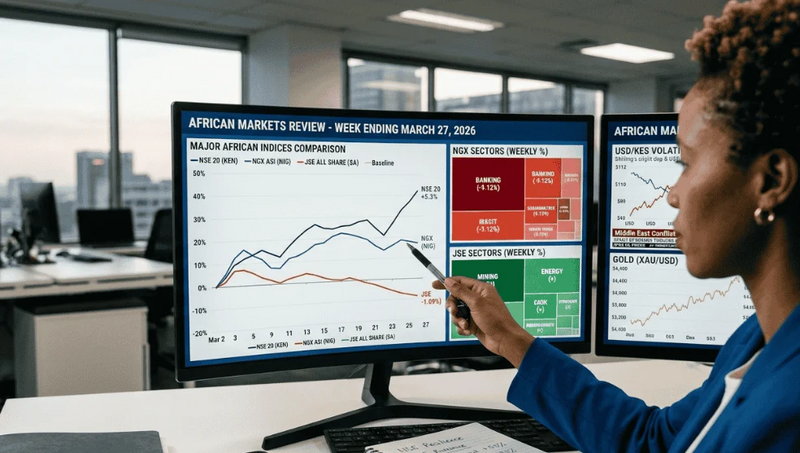
NSESuffered its worst weekly decline since the COVID-19 pandemic, with losses across all major indices.
According to the Central Bank of Kenya Weekly Bulletin released on March 27, 2026, the Nairobi All Share Index (NASI) dropped by 6.21 per cent, while the NSE 25 and NSE 20 share indices declined by 7.85 per cent and 5.86 per cent, respectively.
Data from the NSE showed market capitalization fell 6.66% to KES 3.24 trillion, erasing KES 231.17 billion in investor wealth across five consecutive losing sessions.
Trading Activity: The CBK noted that despite the fall in share prices, total shares traded rose by 17.92 per cent, while equity turnover increased by 35.13 per cent during the week.
Johannesburg Stock Exchange (JSE), South Africa:
The JSE was under a Bearish momentum dominated, with the benchmark heading for its worst month since 2008.
The FTSE/JSE All Share Index fell 0.95% on Friday to close at 111,777.98, marking a -1.09% 5-day decline. The index was down 13% in March through March 27, the most since September 2008.
Sector Impact: The precious metals and mining sector, which accounts for a quarter of the index's weighting, declined by 27% since the start of Middle East conflict .
Nigerian Exchange (NGX), Nigeria
The NGX All-Share Index snapped a three-week winning streak with marginal losses.
According to NGX trading data, the All-Share Index (ASI) fell by 44.83 points, dropping from 200,957.89 to settle at 200,913.06. Market capitalization declined from ₦128.997 trillion to ₦128.969 trillion. Market breadth closed negative with 33 gainers against 36 losers.
Foreign Exchange Volatility Analysis
Currency instability acted as a "signal amplifier" for market moves this week, impacting total returns for international investors.
South African Rand (ZAR): Ended the week under pressure. The South African Reserve Bank (SARB) held its benchmark repurchase rate steady at 6.75% on March 26, with Governor Lesetja Kganyago issuing caution that the bank is navigating a "highly uncertain global environment”. The SARB noted the rand has depreciated approximately 7% against the dollar since the middle east conflict began starting march of 2026.
Nigerian Naira (NGN): Traded between ₦1,360 and ₦1,380 at the official window amid ongoing volatility.
Kenya Shilling (KES): The CBK Weekly bulletin pointed that the shilling traded at KES 129.72 against the US dollar on March 26, with foreign exchange reserves standing at KES 1.82 trillion which is equivalent to 6.0 months of import cover.
Key Driving Factors and Sector Impact
Geopolitical Shock & Oil Prices: Middle East conflict pushed the Brent crude futures to $112.57 per barrel on the Intercontinental Exchange (ICE) as of March 27 an increment from the previous week.
SARB Policy Outlook: The Reserve Bank projected that headline inflation will accelerate to around 4%, with fuel inflation exceeding 18% for the second quarter of the year.
Capital Flows:NSE data revealed foreign investors recorded a net outflow of KES 503.76 million, up from KES 354.93 million the previous week, with selling concentrated on Monday and Friday.
Implications for African Markets Investors
1. Currency Risk Is the Primary Driver of Returns
Local equity gains are being overshadowed by currency volatility. The rand has weakened 7% since conflict began, the naira remains volatile, and the shilling faces sustained import-driven pressure.
StrategicAction: Hedge FX exposure or prioritize markets with stronger reserves (Kenya's 6.0-month import cover offers relative stability.
2. Sector Selection Matters More Than Broad Market Exposure
Not all stocks moved in the same direction. While most indices fell, some sectors gained and others crashed.
March 2026 sector performance breakdown highlighting energy gains, mining collapse, Kenyan banking dividends, and consumer sector risks for investors.
3. Foreign Outflows Signal Continued Risk Aversion
Kenya recorded net outflows of KES 503.76 million (up from KES 354.93 million), while Nigeria faces sustained pressure. Global funds are treating African markets as risk-off until geopolitical clarity emerges reducing their investments in emerging markets as a defense mechanism against uncertainties.
Strategic action: Watch weekly foreign flow data; a reversal would signal the market bottom.
4. Central Bank Policy Divergence Creates Uncertainty
The SARB held at 6.75% despite projected fuel inflation exceeding 18%, signaling growth priority over currency defense. This contrasts with tighter stances elsewhere.
Strategic action: Monitor forward guidance shifts. A hawkish pivot would strengthen currencies but may deepen equity sell-offs.
Bottom Line
Currency is the dominant risk. Until global oil prices stabilizes or central banks rapidly change their monetary policies, FX volatility will continue dictating total returns.
Investors should consider in hedging currency exposure, move toward energy and select mining value, and monitor weekly flow data for early reversal signals in the markets.
What Investors Need to Watch: Key Indicators
Brent crude price.Every $10 increase widens current account deficits for net importers.
Central bank meeting. SARB (May), CBK (April), CBN auctions, a guidance on rates and FX intervention.
Reserve levels. Kenya at 6.0 months import cover. A decline below 4.0 months signals vulnerability.
Foreign portfolio flows. Weekly data from NSE, NGX, and JSE reversals would indicate returning confidence.
Dividend sustainability. Kenyan banking sector payouts may face pressure if outflows continue.
Investor action plan March 2026 with immediate, near-term, and medium-term strategies.
Key Takeaways
Currency Risk Dominates Everything.
Energy Wins, Mining Offers Contrarian Value.
Foreign Capital Is Exiting.
Central Banks Are Diverging.
Watch Oil, Flows, and Reserves.
FAQs: African Stock Market Analysis 2026
1. Why did African markets decline this week? Rising geopolitical tensions and higher oil prices triggered global risk aversion, weakening currencies and pressuring equities.
2.How does FX volatility affect African markets? FX volatility reduces returns for foreign investors and increases economic pressure through inflation and import costs.
3. Which sectors are holding up best? Energy-linked sectors have shown relative resilience, while cyclical and externally exposed sectors remain under pressure.
4. What signals a potential market recovery? Stabilization in oil prices, reduced FX volatility, and a reversal in foreign portfolio outflows.
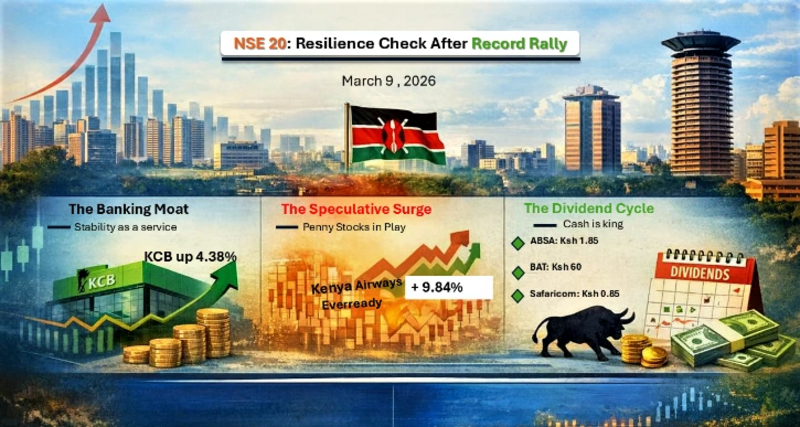
The Nairobi Securities Exchange (NSE) 20 Share Index closed the weekend at 3,604.75, edging up by +18.59 points (+0.52%). While the daily gain appears modest, the underlying volume story is...
Market Pulse (4th December 2025): African equities stayed strong this week, with 12 of 15 major exchanges recording gains. Year-to-date performance remains robust, with several markets among the fastest-growing globally...